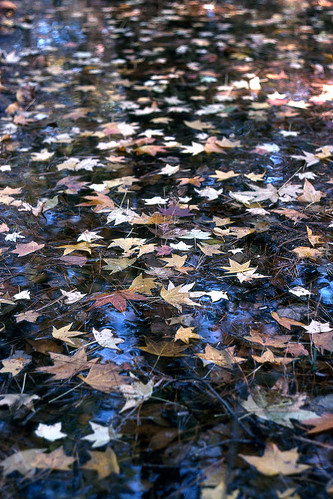
I took this while on a walk with my dog Clancey at a pond near my home in Columbia, SC. I am partial to pictures that have colors/textures spread over the whole, and sort of like this shot. And I love Sweet Gum trees, the gum balls notwithstanding.
Sweet Gum
When I was a kid, maybe 10 or 11 years old, a friend of mine from school lived in a house with a huge backyard – several acres, including a great field for playing baseball. He also had some of the best climbing trees anywhere. My favorite, due to the ease of getting very very high, was a tree with these pointy little balls all over the ground and hanging from the ends of the limbs. I really didn’t know what it was then, but we could climb so high – this tree was higher than the surrounding old loblolly pines, that it was just a great feeling. Of course, being kids, we’d go to the very top and sway back and forth. If poor mom had ever known…
I am of course talking about the venerable old Sweet Gum tree, Liquidambar styraciflua. Seems these days this is one of those trees people most love to hate, mainly because the gum balls are a pain to clean up year after year. Oh the things we come to hate for our perfectly trimmed and chemically produced lawns. “But it hurts to step on them!” Come on, a few weeks running barefooted and you won’t even feel it. Oh I forgot, running barefooted is out. What did Hopkin’s say (from God’s Grandeur):
Generations have trod, have trod, have trod;
And all is seared with trade; bleared, smeared with toil;
And wears man’s smudge and shares man’s smell: the soil
Is bare now, nor can foot feel, being shod
No matter the season, it’s easy to know when you’re standing underneath a Sweet Gum tree. Scattered all around you on the ground are those round prickly balls, about an inch and half in diameter. With little holes between the prickly parts, these balls house the seeds of the Sweet Gum tree, and are referred to as “gum balls.” If it’s winter and you find yourself stepping on gum balls in a parking lot or in someone’s yard, look up, and you’ll usually see many gum balls still hanging onto the tree by their three inch long stems.
These fruit balls provide food to many species of bird and mammal. (Author’s note: on the day of this writing I sat in my car and watched a gray squirrel sitting on a fence in front of me systematically nibble off all the spines of a Sweet Gum ball to get at the enclosed seeds.) So the next time you feel like griping or cursing over all those prickly gum balls, remember, to a lot of animals they are food for the winter. You can learn to love them, you can!
Notice the tree trunk, fairly dark, mildly furrowed, and heavy looking, with somewhat of an “alligator” skin appearance. The limbs tend to come somewhat horizontally off the trunk and are somewhat evenly spaced up and down, to make Sweet Gums, even very large ones, some of the best trees for climbing, as many brave children will attest.
Sweet Gums grow up to 80 to 120 feet, and even taller ones can be found deep in southern bottomland forests, though 60-80 feet may be more normal in GuilfordCounty. There is a great old Sweet Gum right out in front of the clubhouse of Bur-MilPark, worth a look on a beautiful day. In fact, it holds the present county record under the Guilford County Treasure Tree Program, being supposedly 115 feet tall, 49.5 inches in diameter, and having a crown spread of almost 70 feet! I don't think it's that tall, but it is a grand old tree!
The leaves of the Sweet Gum are very distinctive, usually five pointed, six or so inches across, with a star or perhaps starfish shape and appearance. The top of the leaf is glossy or shiny, which, given its star like shape, adds to its beauty. In the fall the Sweet Gum leaves tend to turn a deep crimson red, adding splash to the yellow dominated palate of the piedmont autumn.
If crushed in the hand the leaf has a particular odor called “resinous” by the tree books. That may be the best way to describe the sappy, tart odor.
Often the small branches and twigs of the Sweet Gum have little ridges growing out on each side. These corky ridges called “wings” also show up on "winged elm" trees.
Walk through any field in Guilford County recently abandoned and you will probably find many young Sweet Gums mixed with the usual opportunistic pine trees. Though slower growing than the pines which usually first to take over a field, and thus left in their shade for a time, the Sweet Gum is one of the first hardwoods to rise above the pines and begin the transition from pine to mixed hardwood forest.
So, why is this tree called a “gum” tree anyway. The Sweet Gum tree produces a sap or resin (that flows more freely the farther south you go, giving it the name "liquidambar") that when hardened can be chewed as a gum. This resin of the Sweet Gum tree was long reputed to have medicinal qualities, used for the treatment of skin sores. It was widely used for treatment of dysentery during the Civil War.
The Sweet Gum tree provides one our most important furniture woods, used mainly for veneers, but also for cabinets and boxes and toys, and even as pulpwood.
It’s just a great tree all around.
You can look at more of my pictures on my Flickr site here.
Joel


 Posts
Posts


1 comment:
wow! I would love the challenge of trying to paint this. Composition is perfect. BB
Post a Comment