I didn't think I'd ever sigh and wish for something like a Vancouver winter, but today with the drizzle outside, and given how dry it is, I wish it would just keep doing this for a month - or four. Vancouver is glorious from mid July through October, and then the winter rains set in. Before too long there is interminable cold rain - often with the temperatures never leaving the thirties day or night - just a non stop drizzle. With the short days of winter there would be days when I would trudge the three blocks to the bus stop in the dark rain, take the hour bus ride to school, spend most of the day in the Regent College library, get back on the bus in the dark and rain and go home. Sometimes a cold front would pass through and sweep away the clouds, leaving a beautiful scene such as above. Sometimes it would even snow. And, interestingly, while it would be raining down below in the city, it's snowing about a about 2-3000 feet in the mountains north of the city, providing a base of snow 10 -15 feet for skiing there. Finally Spring hits in April or so, and the flowers come out, and it is beautiful again. Today I long for Vancouver winter. I didn't think I'd ever say that.
Friday, September 14, 2007
Vancouver Winters
I didn't think I'd ever sigh and wish for something like a Vancouver winter, but today with the drizzle outside, and given how dry it is, I wish it would just keep doing this for a month - or four. Vancouver is glorious from mid July through October, and then the winter rains set in. Before too long there is interminable cold rain - often with the temperatures never leaving the thirties day or night - just a non stop drizzle. With the short days of winter there would be days when I would trudge the three blocks to the bus stop in the dark rain, take the hour bus ride to school, spend most of the day in the Regent College library, get back on the bus in the dark and rain and go home. Sometimes a cold front would pass through and sweep away the clouds, leaving a beautiful scene such as above. Sometimes it would even snow. And, interestingly, while it would be raining down below in the city, it's snowing about a about 2-3000 feet in the mountains north of the city, providing a base of snow 10 -15 feet for skiing there. Finally Spring hits in April or so, and the flowers come out, and it is beautiful again. Today I long for Vancouver winter. I didn't think I'd ever say that.
Thursday, September 13, 2007
Photo of the Day - September 13, 2007 - Three Brothers
"Mike, Bobby and Joe," as folks in Columbia would refer to us Gillespie brothers. This was taken last Thanksgiving in my brother Bobby's front yard, late in the afternoon of Thanksgiving Day. Obviously somebody said something funny. Bobby's expression is priceless! So how come I'm the only one with hair? Oops, some hidden corner of the not yet transformed pagan in me just wished I hadn't said that!
Wednesday, September 12, 2007
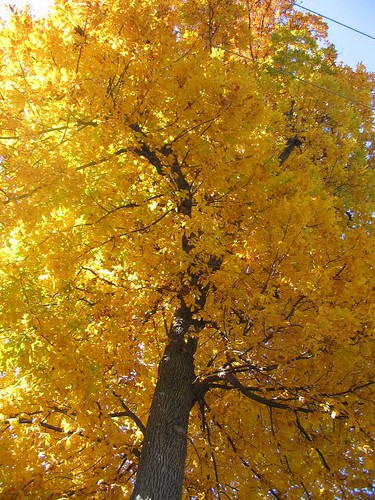
Photo of the Day - September 12, 2007 - Remembering Last Autumn
Tuesday, September 11, 2007
Don't Be Talking About My Wiki (or Translation Please)
I read the following on The Starry Dynamo's site. It sounds fascinating - AND I HAVE NO IDEA WHAT SHE IS TALKING ABOUT :-) . Translation anyone? And I hate to ask, but, what is a wiki? I just want to know if I should be concerned about somebody talking about my wiki that way.
"I am one week out with my instance of MediaWiki on a WAMP stack and am surprised at how easy it is to manipulate the CSS and PHP. Particularly with CSS it is very easy to customize the look and feel of your wiki. I consider myself to have above average technical skills but was skeptical that I would be able to wade through the language. PHP looks so foreign, but made more sense the longer I stayed in there. I have been experimenting adding color, customizing the sidebar and adding extensions. There are two sites that are great examples of how MediaWiki can be customized."
Please Clouds, Bring Rain
Whether liberal or conservative, straight or gay, male or female, Tarheel or Blue Devil or Demon Deacon, white or black or neither -- I think we can all look up in the sky on a day like today and say or think something like "please clouds, bring rain!" I mean, that's something, right?
The Cost of Chaos
Applied Rationality has a good piece today on the cost of our ongoing presence in Iraq, including the ongoing costs even if we pull out in a reasonably quick but responsible fashion. He compares this expense to what we are spending in other areas. In his words:
“To provide some perspective about the size of the funds, the $116 billion that has been requested for Iraq in FY 2008 is larger than the combined budgets of all federally-funded education, training, and social service programs ($83 billion), energy programs ($1.4 billion), and community and regional development programs ($25 billion). Alternatively, it accounts for roughly half of the projected federal deficit for FY 2008.”
Apart from the fact that I think the federal government is terribly inefficient, arbitrary and borderline corrupt in spending large sums of money (e.g., post Katrina spending), it is hard not to imagine what amount of security and economic growth and energy independence could have been created by spending that amount of money in other ways – education, energy R&D, biotechnology, welfare to work programs, etc. And of course, knowing me, I am inclined to imagine how many endangered habitat could have been saved.
However, here is my concern. Are we accounting for the very possible if not probable costs to us of being in a position of having to re-enter the fray after all hell breaks loose in the region after we leave? I know that many would say that had we not gone in in the first place we wouldn’t have to think of the post withdrawal chaos. Well, maybe so, but we did, and we do. We made our bed and now we have to sleep in it. So has someone charted out the several possible post-withdrawal scenarios that could see us re-engaged in a different capacity, and what they each could possible also cost us? Could it be worse? I wonder. I just think we need to see that spelled out before we can make a rational assessment and evaluation of the real financial costs related to our ongoing current occupation of Iraq.
“To provide some perspective about the size of the funds, the $116 billion that has been requested for Iraq in FY 2008 is larger than the combined budgets of all federally-funded education, training, and social service programs ($83 billion), energy programs ($1.4 billion), and community and regional development programs ($25 billion). Alternatively, it accounts for roughly half of the projected federal deficit for FY 2008.”
Apart from the fact that I think the federal government is terribly inefficient, arbitrary and borderline corrupt in spending large sums of money (e.g., post Katrina spending), it is hard not to imagine what amount of security and economic growth and energy independence could have been created by spending that amount of money in other ways – education, energy R&D, biotechnology, welfare to work programs, etc. And of course, knowing me, I am inclined to imagine how many endangered habitat could have been saved.
However, here is my concern. Are we accounting for the very possible if not probable costs to us of being in a position of having to re-enter the fray after all hell breaks loose in the region after we leave? I know that many would say that had we not gone in in the first place we wouldn’t have to think of the post withdrawal chaos. Well, maybe so, but we did, and we do. We made our bed and now we have to sleep in it. So has someone charted out the several possible post-withdrawal scenarios that could see us re-engaged in a different capacity, and what they each could possible also cost us? Could it be worse? I wonder. I just think we need to see that spelled out before we can make a rational assessment and evaluation of the real financial costs related to our ongoing current occupation of Iraq.
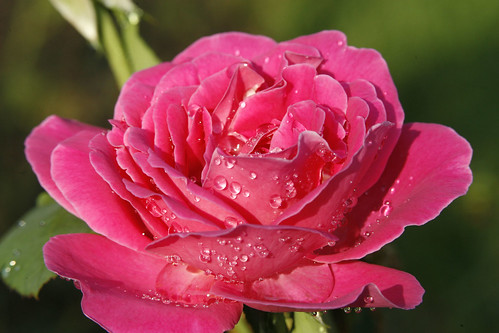
Photo of the Day - September 11, 2007 - A Red Rose on 9/11
Saturday, September 08, 2007
Can We Not Pull for and Hope for Success in Iraq?
Joe Guarino provides a link to an article by Kimberly Kagan of the Wall Street Journal, and review of that article on the site Captain’s Quarters. The gist of Kagan’s article seems to be the success of the surge – the surprising success.
From the multiplicity of the reports coming back from Iraq it seems to be that there are many reasons to be very cautiously optimistic. Is not the ideal outcome that the surge would be successful, and Iraq would be stabilized?
But, as things appear to me, there are many politicians and pundits who want the Iraq effort to fail, and there are those those who would paint an overly optimistic assessment. Once again, from where I sit, it seems that our own political divisions are making it hard for us to assess accurately the situation. yet there is enough testimony and apparently compelling evidence that there are good things happening - and that from people who are not Bush stooges - to think something is going right for a change.
It seems to me that we should all be hoping and praying that, despite all that has gone wrong, the tide will turn, and things will go right. It is certainly in the interest of the Iraqi people that things get better. It would also be in our armed forces interest, and in the interest of our national security and financial stability. It seems the only people who would lose if things were to get better are the Iranians, Al-Qaeda, and all those who politically need to see this fail in order to be or feel vindicated.
And regarding all the talk about the money being spent, yes, it’s astronomical. Yes, it could be used on other things. But I would like someone to paint for me a realistic scenario whereby our effort there fails, we pull out, the surrounding powers jump in , and the situation does not end up pulling us back in and under possibly very worse circumstances and into a broader and even more expensive war, because I just cannot see it.
I cannot understand what seems to me to be at least an appearance of a deep seated desire for this whole thing to fail. That just bothers and disturbs me very much.
And could we possibly lay off the Iraqi government just a little. Go back and read about our own national beginnings. There was enough division and intrigue to fill a hundred books – oh yeah, they’ve been written, and are being written. We are expecting the Iraqi people, with their multi religions and ethnicities, complex histories of deep seated distrust, including some who have killed and brutalized others, to sit down together and smoke peace pipes and play “All You Need Is Love”?
I think maybe we don’t appreciate how hard the process is. Who are we to lecture their leadership? Look at our own divided mess here.
Of course the war and its aftermath were handled poorly. I don’t hear anyone disputing that. But we are where we are. And it just seems to me that we should hope and pray that these more optimistic assessments coming from various quarters to be realistic. It is in the interest of all decent people that we succeed. The situation is no doubt fragile and this is no time for popping corks. But maybe it is a time for hope.
From the multiplicity of the reports coming back from Iraq it seems to be that there are many reasons to be very cautiously optimistic. Is not the ideal outcome that the surge would be successful, and Iraq would be stabilized?
But, as things appear to me, there are many politicians and pundits who want the Iraq effort to fail, and there are those those who would paint an overly optimistic assessment. Once again, from where I sit, it seems that our own political divisions are making it hard for us to assess accurately the situation. yet there is enough testimony and apparently compelling evidence that there are good things happening - and that from people who are not Bush stooges - to think something is going right for a change.
It seems to me that we should all be hoping and praying that, despite all that has gone wrong, the tide will turn, and things will go right. It is certainly in the interest of the Iraqi people that things get better. It would also be in our armed forces interest, and in the interest of our national security and financial stability. It seems the only people who would lose if things were to get better are the Iranians, Al-Qaeda, and all those who politically need to see this fail in order to be or feel vindicated.
And regarding all the talk about the money being spent, yes, it’s astronomical. Yes, it could be used on other things. But I would like someone to paint for me a realistic scenario whereby our effort there fails, we pull out, the surrounding powers jump in , and the situation does not end up pulling us back in and under possibly very worse circumstances and into a broader and even more expensive war, because I just cannot see it.
I cannot understand what seems to me to be at least an appearance of a deep seated desire for this whole thing to fail. That just bothers and disturbs me very much.
And could we possibly lay off the Iraqi government just a little. Go back and read about our own national beginnings. There was enough division and intrigue to fill a hundred books – oh yeah, they’ve been written, and are being written. We are expecting the Iraqi people, with their multi religions and ethnicities, complex histories of deep seated distrust, including some who have killed and brutalized others, to sit down together and smoke peace pipes and play “All You Need Is Love”?
I think maybe we don’t appreciate how hard the process is. Who are we to lecture their leadership? Look at our own divided mess here.
Of course the war and its aftermath were handled poorly. I don’t hear anyone disputing that. But we are where we are. And it just seems to me that we should hope and pray that these more optimistic assessments coming from various quarters to be realistic. It is in the interest of all decent people that we succeed. The situation is no doubt fragile and this is no time for popping corks. But maybe it is a time for hope.
Friday, September 07, 2007
Bloxorz
My very good friend Sam, at my request, sent me a link to a very cool online game sight called Mousebreaker. There is one game called Bloxorz that is very cool.
Except, how am I supposed to get ANY work done now?
Richland Creek Is Dry
About an hour ago I drove north on Lawndale Drive past the Food Lion (in the old Winn-Dixie building) and noticed that Richland Creek (that flows through Country Park and Battleground Park, and after crossing under Cottage Place and Lawndale Drive, eventually empties into Lake Jeanette) was completely dried up – no water flowing at all. I don’t remember that happening even in the terrible drought of a few years ago.
My garden is dying; including some beloved shrubs and bushes – such as one of our two Rhododendrons and my beloved Tea Olive. The particular Rhododendron should not have been planted where it was – but it was there when we bought the house. I planted the Tea Olive myself. It’s hard to know how much I should water them given the state of things. I am PRAYING that that tropical depression makes its way right to us and gives us a whole lot of rain.
John Edward's House (and how it saps his credibility to me)
I just read Time Magazine’s article (in the Sept. 10 edition - see also here) about the John Edward’s campaign - "Why Iowa Loves John Edwards - And how he's betting the farm on their support." Time gives much credit for the renewed vigor of Edward’s campaign to his war on poverty tour, or whatever exactly it was called in the article.
Though I am not terribly fond of Edwards’ style or persona, I admire him for defying conventional wisdom and leaning as far left as he has. And I am glad someone is drawing attention to the more needy amongst us.
As a practicing Christian and a Christian pastor, I believe that the manner in which we as a nation treat the poorest and weakest among us is of profound significance and importance. I have studied significantly what the bible has to tell us on the matter, and though it does not tell us what role a secular government should play or not play, it tells us much about how we are to act. I have written about this in my Caring for the Poor and Needy: the Biblical Mandate.
We all share a responsibility to care about the lives of widows and orphans and the poor and “strangers and aliens” – and to do more than just care: even as James says in his epistle:
“Religion that is pure and undefiled before God, the Father, is this: to visit orphans and widows in their affliction, and to keep oneself unstained from the world (James 1:27).”
But I just cannot get past the fact that John Edwards lives in one of the biggest houses in Orange County. Hey, I am all for a guy making money – more power to him. But to preach and advocate governmental responsibility to the poor, and yet to live out an appearance of such conspicuous consumption, well, it just bugs me. It makes him seem disingenuous. It saps his credibility to me.
I suppose it may be asking too much of any of us to address this issue in a way that not partisan, but I’d like to know how others feel about this.
Though I am not terribly fond of Edwards’ style or persona, I admire him for defying conventional wisdom and leaning as far left as he has. And I am glad someone is drawing attention to the more needy amongst us.
As a practicing Christian and a Christian pastor, I believe that the manner in which we as a nation treat the poorest and weakest among us is of profound significance and importance. I have studied significantly what the bible has to tell us on the matter, and though it does not tell us what role a secular government should play or not play, it tells us much about how we are to act. I have written about this in my Caring for the Poor and Needy: the Biblical Mandate.
We all share a responsibility to care about the lives of widows and orphans and the poor and “strangers and aliens” – and to do more than just care: even as James says in his epistle:
“Religion that is pure and undefiled before God, the Father, is this: to visit orphans and widows in their affliction, and to keep oneself unstained from the world (James 1:27).”
But I just cannot get past the fact that John Edwards lives in one of the biggest houses in Orange County. Hey, I am all for a guy making money – more power to him. But to preach and advocate governmental responsibility to the poor, and yet to live out an appearance of such conspicuous consumption, well, it just bugs me. It makes him seem disingenuous. It saps his credibility to me.
I suppose it may be asking too much of any of us to address this issue in a way that not partisan, but I’d like to know how others feel about this.
How to Avoid God
A friend sent to me a great quote from CS Lewis, that I thought I would share, along with my friend's intro:
C.S. Lewis would not give advice for pursuing God, having always felt like the one being pursued. But he did make some suggestions for promoting God’s absence which should give us some hints about independence from the flow of our culture. “Avoid silence, avoid solitude, avoid any train of thought that leads off the beaten track. Concentrate on money, sex, status and (above all) on your grievances. Keep the radio on. Live in a crowd. Use plenty of sedation. If you must read books, select them very carefully. But you’d be safer to stick to the papers. You’ll find the advertisements helpful; especially those with a sexy or a snobbish appeal.”
Thursday, September 06, 2007
My Stupid Poem
No More Clinton
No more Bush
Time to give them
Both a push
Twenty Years is
Long enough
I’m so tired of
All their stuff
Let us have
Barach Obama
He’ll send ‘em in
To find Osama
Let us have that
Thompson dude
If he is picked
Osama’s screwed
We don’t need
Another dufus
Saying things that
Just confuse us
We don’t need
Another bear
Who panders to
Who’s sitting there
Time for change
Time for newness
Time to shake off
All this blueness
To Hillary
Goodbye I say
To Billary
To W
Goodbye I say
To brothers too
No more
No more Bush
Time to Give them
All a push
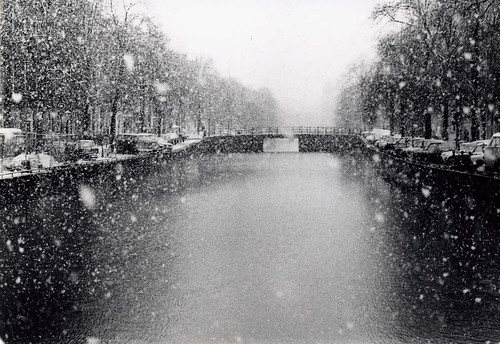
Photo of the Day - Thursday September 6, 2007 - Snowfall in Amsterdam
Wednesday, September 05, 2007
pandora.com - way cool
My friend Brad turned me on to Pandora (www.pandora.com) and I am totally digging it. I am using the free service so far. Basically you type in an artist or a song and it creates a “station” (as in radio station) of music that shares similar characteristics, and presents the songs one after another. You don’t know what’s coming, and you can’t choose a particular song to play, though by clicking “thumbs up” or ‘thumbs down” for each song you can “teach” Pandora what songs you want to hear or not hear. I have about ten stations of different genres. For each song you can click on an icon and get detailed information about the song, the album, or the artist. It is a super way to hear both music you like and music which you may not have known before. I’ve discovered I really like the band “Wilco” about which I had known pretty much nothing. I have a hard time working in total quiet, and it’s great to have the music playing in the background, and if I want to pause and listen closely I can do that. You should check it out.
Try Again - After Larry Craig: Let's Reconsider Chastity
OK, I was up too late and butchered the English language on my post from 1:00am or whenever it was. Good grief, I didn't even spell "Larry" right. I have corrected it, much to the relief of my language-loving friends, and if you want just follow this link for the corrected version - After Larry Craig: Let's Reconsider Chastity. And yes, I think he should resign.
Cool It
Bjørn Lomborg’s new book, “Cool It: The Skeptical Environmentalist's Guide to Global Warming,” will, hopefully, add positively to the debate regarding global warming and it’s impact upon the earth over the next hundred years.
At this point I support almost anything that falls between global warming hysteria on the one hand and conspiracy theorists on the other. Open minded discussion devoid of strong arming on either side would be nice.
But what we really need is a wider-spread ethic of creation care. OK, I grant, not everyone can embrace my use of the word “creation.” Such implies a creator, and some folks can't go with that. If you’re one of those folks, translate my phrase as “ethic of earth care” if you’d like.
In the end it should not be fear that motivates us to care for this good earth upon which we have been set. Ultimately what should motivate us is virtue, love, stewardship, and moderation.
Love of God is a good motivator – it is His earth and we should not be poisoning it and ripping it apart to satisfy our lust and greed. We should not be wiping his wonderful creatures off the map either.
But love of neighbor should also be a good motivator. How we treat the earth, what we put into the air and water – all this impacts other people. Do we want to do good to our neighbor or harm to our neighbor?
Love of creation itself is a good motivator. Some have called this “biophilia,” and it speaks to that bond we have (or our better selves have) with the living creatures and systems around us.
The virtue of moderation is another good reason to care about the earth. How many of our environmental problems are caused by unbridled and conspicuous consumption – consumption which requires unsustainable use of limited resources. Contentment, moderation, gratitude – the exercise of these virtues alone would impact our world for the better in countless ways.
And this brings up the virtue of stewardship, the wise and sustainable use of that which has been given to us. Stewardship is a virtue. Good stewardship would cause us to look closely at our patterns of life. Good stewardship leads to moderation, conservation, recycling, and loving care of fragile ecosystems and their biodiversity. Those ecosystems have not only animals and plants that we do better to love than to abuse, but they also contain the future cures for many if not most human diseases. We have barely begun to understand the relationship between rare bio-chemicals in this plant or that fungus, and our own diseases.
Good stewardship protects and defends the good and beautiful things which are given to us, as it were, as a gift. Beauty is a central part of the human experience. The absence of it harms our souls and strangles our spirits. We are less without it. As a species, to a great extent, according to our stewardship of a beauty we received but did not create, we play a role in whether beauty remains. It is a gift to be cherished and protected, as good stewards do.
Good stewardship keeps in mind the generation to come after us. What do we want to bequeath to them? Would the virtue of good stewardship not want to give to our children and children’s children an even better and more beautiful world than we have received from our fathers and mothers? I think so.
This is, again, why putting global warming up front as the be all and end all environmental issue concerns me. Eliminate that from your mind and you still have hundreds of reasons to practice an ethic of creation care, or earth care, and hundreds of ways, big and small, to make this world a better place for all who inhabit it.
At this point I support almost anything that falls between global warming hysteria on the one hand and conspiracy theorists on the other. Open minded discussion devoid of strong arming on either side would be nice.
But what we really need is a wider-spread ethic of creation care. OK, I grant, not everyone can embrace my use of the word “creation.” Such implies a creator, and some folks can't go with that. If you’re one of those folks, translate my phrase as “ethic of earth care” if you’d like.
In the end it should not be fear that motivates us to care for this good earth upon which we have been set. Ultimately what should motivate us is virtue, love, stewardship, and moderation.
Love of God is a good motivator – it is His earth and we should not be poisoning it and ripping it apart to satisfy our lust and greed. We should not be wiping his wonderful creatures off the map either.
But love of neighbor should also be a good motivator. How we treat the earth, what we put into the air and water – all this impacts other people. Do we want to do good to our neighbor or harm to our neighbor?
Love of creation itself is a good motivator. Some have called this “biophilia,” and it speaks to that bond we have (or our better selves have) with the living creatures and systems around us.
The virtue of moderation is another good reason to care about the earth. How many of our environmental problems are caused by unbridled and conspicuous consumption – consumption which requires unsustainable use of limited resources. Contentment, moderation, gratitude – the exercise of these virtues alone would impact our world for the better in countless ways.
And this brings up the virtue of stewardship, the wise and sustainable use of that which has been given to us. Stewardship is a virtue. Good stewardship would cause us to look closely at our patterns of life. Good stewardship leads to moderation, conservation, recycling, and loving care of fragile ecosystems and their biodiversity. Those ecosystems have not only animals and plants that we do better to love than to abuse, but they also contain the future cures for many if not most human diseases. We have barely begun to understand the relationship between rare bio-chemicals in this plant or that fungus, and our own diseases.
Good stewardship protects and defends the good and beautiful things which are given to us, as it were, as a gift. Beauty is a central part of the human experience. The absence of it harms our souls and strangles our spirits. We are less without it. As a species, to a great extent, according to our stewardship of a beauty we received but did not create, we play a role in whether beauty remains. It is a gift to be cherished and protected, as good stewards do.
Good stewardship keeps in mind the generation to come after us. What do we want to bequeath to them? Would the virtue of good stewardship not want to give to our children and children’s children an even better and more beautiful world than we have received from our fathers and mothers? I think so.
This is, again, why putting global warming up front as the be all and end all environmental issue concerns me. Eliminate that from your mind and you still have hundreds of reasons to practice an ethic of creation care, or earth care, and hundreds of ways, big and small, to make this world a better place for all who inhabit it.
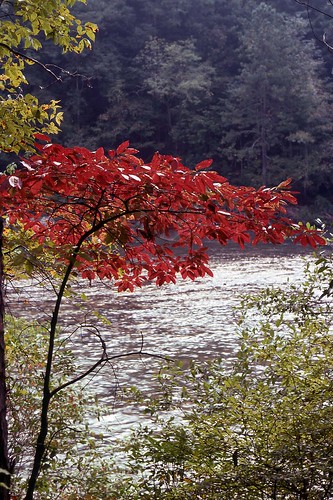
Photo of the Day - September 5, 2007 - September Along the Chattooga
Subscribe to:
Posts (Atom)