My body was made for motion, not for sitting here all day at my desk. I should be hunting buffalo, walking behind a plow, riding a horse, building a barn, or felling a tree and digging up the stump.
But I’m here. Most of my friends at this moment are in the same position. Sitting. Body systems rebel. Veins, arteries, intestines, muscles, bladders, hearts, and lungs thrive with bodily movement and hard pumping blood. Sitting here, the whole body just gets clogged up.
Most of my friends cannot afford to do what they would really like to do. The rugged manual labor they desire cannot pay for mortgage, car, braces, clothes, and college. There is tragedy here. The economic system has us in its claws, and it won’t let go.
Vocationally, my brain is pitted against my body. My work is largely mental. I exercise dominion through thought - studying, writing, talking on the phone, praying, doing paper work, conversing at a restaurant. Frankly, I have great job. But my body gets the short end of the stick.
The paper piles up. It is my enemy. How do I love this enemy? It reproduces at night when I’m gone. One pile becomes two, two becomes four, and the tension builds. I end up carving out an entire day to attack the piles.
“You need more exercise,” the doctor says. “Your blood pressure is too high, your cholesterol is too high, your weight is too high.”
Fine, doctor. But when? Do I take time from my wife, my kids, or my employer? How do I do it all? How do I fit it all in, doctor?
I don’t want the never ending cycle of antibiotics for prostate infections, laxatives for constipation, aspirin for headaches, and antacids for indigestion. I don’t want to be flabby and sleepy from inactivity. I want to be strong, vigorous, and awake. I want to be energetic and productive.
I don’t want to die when I’m fifty five from clogged arteries. I don’t want to spend my last years undergoing chemotherapy for bowel cancer. I want to see my five daughters grow up. I want to know my grandkids, and maybe even my grandkids' kids. I want to have the wisdom of years. I want to keep learning how to be a good pastor, that is, if being a pastor doesn’t kill me.
Why can’t exercise be a part of my work? Why do I have to “find the time” to do it?
I know. Whining won’t help. I’m being a baby. I’m singing the blues, the white collar blues. I should count my blessings. I have a great job. It really couldn’t be better. I am stimulated, challenged, and encouraged. I am appreciated, loved, and valued. I have the rare privilege of actually wanting to attend the church that I pastor. There is no group of people I would rather be with.
But I still don’t want to croak from plaque build up. I still don’t want to have the muscle definition of a wet noodle. Where will I find the time to carve out an hour and a half a day to exercise? I don’t have the time. I don’t have the time not to. I must. Somehow.
I’ve been trying to walk/run four miles as many days as possible. Granted, it’s not felling trees and hunting buffalo, but it’s a start. I’m working on filling up several other hours of my week with similar activity. I hope it works. It has to.
I need to follow my own counsel. I need to remind myself that I too live in a fallen world. What are paper piles but modern day versions of thorns and thistles? Did I really think God would grant Joel Gillespie a personal exemption from the curse?
Though the system seems to have me by its claws, it has also brought good things my way for which I am very thankful, things like this computer, like the medicine that healed my daughter’s bronchitis, like electricity and phones and a warm place on a cold night, like angioplasty...
And maybe we can go buffalo riding in the New Heaven and New Earth. I hope so.
Wednesday, October 10, 2007


Monday, October 08, 2007
See 'Ya Around
I am the most fickle blogger I know. I have to stop being fickle. I turn 50 and I can't manage to do anything well it seems! Anyway, to all of you out there, just thought I'd say Sayōnara. I am going to be signing off today, probably for good. I'll give it a week or so before I make the sight go invisible. Just need to put my energies elsewhere. It's been fun, despite being off and on for me, and I appreciate you all. Maybe I'll see you around the city. Joel.
Thursday, October 04, 2007
On Dobson, Guliani, and Being Pro-Family
Having spent some time distancing myself from Dobson and company this week, I will now come to their defense, well, a little.
Ed Cone noted today that James Dobson had issued a statement to the effect that he and other “pro-family” leaders would look elsewhere if a Republican presidential nominee could not take a clear position regarding the sanctity of human life.
Ed goes on to take issue with Dobson and Co’s use of the “pro-family” rubric or designation.
James Dobson, along with many others, including myself, believe that human life is sacred and that it begins at conception. Sacred human life includes the lives of the weak and infirm, the handicapped, the homeless, and the mothers of unborn children – all human life.
I myself would or could never ever vote for a person who actively advocated for abortion rights.
In one sense, if we’re talking about abortion it might be better to call Dobson, the Pope, and anyone else who holds this view “pro-life” rather than "pro-family." Yet, if one views unborn life as human life, and as sacred, he would consider that yet-unborn life as part of the family of whoever was bearing the child. So, there is an overlap between these designations. Would a person be considered “pro-family” who advocated for infanticide-rights? I doubt it. I would suspect that most folks reading this, even if they didn’t agree with the comparison of abortion and infanticide, would grant the point that being “pro-infanticide rights” might not be consistent with being “pro-family.”
Well, pro-life folks believe that abortion is a form of infanticide. So, if being pro-infanticide rights would not be considered pro-family, then to a pro-life person, being pro-abortion rights would not be considered pro-family either.
But the rubric of “pro-family” is broader than just the issue of abortion. It includes views about marriage, about marriage and divorce, about the relative intrusion or non intrusion of the state into essential family issues. Obviously Ed and others who may be more supportive of abortion rights, gay marriage, and no fault divorce (I don’t know Ed’s view on that issue) may indeed have wonderful families and care a lot about families. They may even be pro-abortion rights or pro-gay marriage because of the way that they are, in their minds, pro-family. And, as can be easily pointed out, there are many things which bring harm to children (even unborn children), and to others who are weak and defenseless, which are not on the radar of pro-family groups like Dobson’s.
So it might be better to change the rubric to “pro-traditional family,” or something like that, and it would be better yet for pro-traditional family advocates to be more broadly and consistently pro-life and pro-family and weigh in on issues where the lives of children and needy adults are at stake, even economic issues whereby families are torn apart due to extreme financial pressure or lives are lost due to unavailability of health care.
This is where I part somewhat with Dobson, because I would like to see pro-traditional family advocates be more consistent and not cherry pick just the abortion or gay marriage issues. Many issues impact human life and impact families.
As to voting for Guliani, that will hard for me as well. I may take some comfort in the nuanced manner in which he has taken his abortion position. It appears that he is hiding behind the courts, and that he might prefer to address the issue through the appointing of more strictly constructionist judges. I have yet to discover his view on partial birth abortion, an issue where legislation has made a big difference. I could never vote for a person who supported the rights of women and doctors to abort partially born babies, or to allow babies who have survived abortions to die – even if you held a big gun to my head. Go ahead and shoot. It won’t be happening.
But for Dobson and all to support a third party candidate will almost certainly give the election to the Democrats. Maybe Dobson would prefer this – it would certainly give him lots of debating and fundraising grist for four to eight years, and it would allow the American public to become re-energized as they see the impact of a Democratic president and congress with respect to these issues. I think it may be foolish however for the pro-life cause since, all things considered, even Guliani will be more sympathetic to Dobson’s issues than the average Democrat, or Hillary Clinton, especially in the naming of judges. It may be a cynical gamble for them to abandon the Republican nominee.
I agree with Ed that this may be just bluster when the rubber actually meets the road. We’ll see how high minded these folks are when faced with a likely win by a serious and consistent abortion rights advocate on the other side.
Ed Cone noted today that James Dobson had issued a statement to the effect that he and other “pro-family” leaders would look elsewhere if a Republican presidential nominee could not take a clear position regarding the sanctity of human life.
Ed goes on to take issue with Dobson and Co’s use of the “pro-family” rubric or designation.
James Dobson, along with many others, including myself, believe that human life is sacred and that it begins at conception. Sacred human life includes the lives of the weak and infirm, the handicapped, the homeless, and the mothers of unborn children – all human life.
I myself would or could never ever vote for a person who actively advocated for abortion rights.
In one sense, if we’re talking about abortion it might be better to call Dobson, the Pope, and anyone else who holds this view “pro-life” rather than "pro-family." Yet, if one views unborn life as human life, and as sacred, he would consider that yet-unborn life as part of the family of whoever was bearing the child. So, there is an overlap between these designations. Would a person be considered “pro-family” who advocated for infanticide-rights? I doubt it. I would suspect that most folks reading this, even if they didn’t agree with the comparison of abortion and infanticide, would grant the point that being “pro-infanticide rights” might not be consistent with being “pro-family.”
Well, pro-life folks believe that abortion is a form of infanticide. So, if being pro-infanticide rights would not be considered pro-family, then to a pro-life person, being pro-abortion rights would not be considered pro-family either.
But the rubric of “pro-family” is broader than just the issue of abortion. It includes views about marriage, about marriage and divorce, about the relative intrusion or non intrusion of the state into essential family issues. Obviously Ed and others who may be more supportive of abortion rights, gay marriage, and no fault divorce (I don’t know Ed’s view on that issue) may indeed have wonderful families and care a lot about families. They may even be pro-abortion rights or pro-gay marriage because of the way that they are, in their minds, pro-family. And, as can be easily pointed out, there are many things which bring harm to children (even unborn children), and to others who are weak and defenseless, which are not on the radar of pro-family groups like Dobson’s.
So it might be better to change the rubric to “pro-traditional family,” or something like that, and it would be better yet for pro-traditional family advocates to be more broadly and consistently pro-life and pro-family and weigh in on issues where the lives of children and needy adults are at stake, even economic issues whereby families are torn apart due to extreme financial pressure or lives are lost due to unavailability of health care.
This is where I part somewhat with Dobson, because I would like to see pro-traditional family advocates be more consistent and not cherry pick just the abortion or gay marriage issues. Many issues impact human life and impact families.
As to voting for Guliani, that will hard for me as well. I may take some comfort in the nuanced manner in which he has taken his abortion position. It appears that he is hiding behind the courts, and that he might prefer to address the issue through the appointing of more strictly constructionist judges. I have yet to discover his view on partial birth abortion, an issue where legislation has made a big difference. I could never vote for a person who supported the rights of women and doctors to abort partially born babies, or to allow babies who have survived abortions to die – even if you held a big gun to my head. Go ahead and shoot. It won’t be happening.
But for Dobson and all to support a third party candidate will almost certainly give the election to the Democrats. Maybe Dobson would prefer this – it would certainly give him lots of debating and fundraising grist for four to eight years, and it would allow the American public to become re-energized as they see the impact of a Democratic president and congress with respect to these issues. I think it may be foolish however for the pro-life cause since, all things considered, even Guliani will be more sympathetic to Dobson’s issues than the average Democrat, or Hillary Clinton, especially in the naming of judges. It may be a cynical gamble for them to abandon the Republican nominee.
I agree with Ed that this may be just bluster when the rubber actually meets the road. We’ll see how high minded these folks are when faced with a likely win by a serious and consistent abortion rights advocate on the other side.
Picture of the Day - October 4, 2007 - Highway 61, Revisited
 A Guilford County NC Farm, May 2006, off Highway 61, SE Guilford County (enjoy it - these scenes are disappearing fast!)
Confessions of a Lazy Carnivore
I appreciated Sarah Beth Jone's piece today entitled "Tabletop activism: the case for conscientiously raised meat." You should check it out.
Sarah Beth is not making an argument for vegetarianism. Rather, she addresses the primary health and ethical concerns about the way we raise, treat, and feed animals. In doing so she offers advice on how to be a responsible and morally conscientious omnivore. I completely agree with her. But I confess that it is so hard to DO everything that I think is right and best.
I wish I could afford a Prius: I can't. I wish I could afford solar panels on my house: I can't. As far as making the best decisions as a consumer, well, I can barely stay on top of things in my life as they are. I am one of those guys who is terrified of grocery shopping, and to avoid getting lost in the dark back alleys of the grocery store I grab what's close and run.
But I want to be the ethically responsible omnivore that Sarah Beth writes about. I do believe that the manner in which the meat industry for the most part raises cows and pigs and chickens is unconscionable. Even a cow deserves a life consistent with his "cowness." And (of course, blah blah) I believe that we humans have a special responsibility toward the well being of our fellow creatures.
The manner in which cows are fed and medicated is also a concern. The corn that is fed to cows results in nice marbled juicy meat, that is, fatty meat. Add this to all the antiobiotics and hormones cows are forced to eat and what is left is meat that is NOT nearly as good for us as meat could be.
I have always been burdened by one other matter. It takes an unbelievable amount of corn to feed cows so we can have marbled meat. Cows have bacteria in their systems which allow them to digest cellulose; they are made to eat grasses which we cannot eat and digest. So we feed them corn, which could be used to feed people, and keep them from eating grass, which people cannot eat. Something does not seem square about that.
I want to be what Sarah Beth writes about, a conscientious omnivore. If only I can find time in the schedule to get out to the farmers market to buy that meat which is better for me which allows for a better life for the cow.
Joel
Sarah Beth is not making an argument for vegetarianism. Rather, she addresses the primary health and ethical concerns about the way we raise, treat, and feed animals. In doing so she offers advice on how to be a responsible and morally conscientious omnivore. I completely agree with her. But I confess that it is so hard to DO everything that I think is right and best.
I wish I could afford a Prius: I can't. I wish I could afford solar panels on my house: I can't. As far as making the best decisions as a consumer, well, I can barely stay on top of things in my life as they are. I am one of those guys who is terrified of grocery shopping, and to avoid getting lost in the dark back alleys of the grocery store I grab what's close and run.
But I want to be the ethically responsible omnivore that Sarah Beth writes about. I do believe that the manner in which the meat industry for the most part raises cows and pigs and chickens is unconscionable. Even a cow deserves a life consistent with his "cowness." And (of course, blah blah) I believe that we humans have a special responsibility toward the well being of our fellow creatures.
The manner in which cows are fed and medicated is also a concern. The corn that is fed to cows results in nice marbled juicy meat, that is, fatty meat. Add this to all the antiobiotics and hormones cows are forced to eat and what is left is meat that is NOT nearly as good for us as meat could be.
I have always been burdened by one other matter. It takes an unbelievable amount of corn to feed cows so we can have marbled meat. Cows have bacteria in their systems which allow them to digest cellulose; they are made to eat grasses which we cannot eat and digest. So we feed them corn, which could be used to feed people, and keep them from eating grass, which people cannot eat. Something does not seem square about that.
I want to be what Sarah Beth writes about, a conscientious omnivore. If only I can find time in the schedule to get out to the farmers market to buy that meat which is better for me which allows for a better life for the cow.
Joel
Tuesday, October 02, 2007
Picture of the Day - October 2, 2007 - Baseball on My Mind
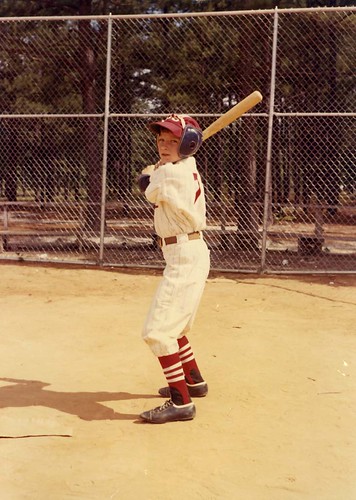 "Minor League" or pre-Little League, Satchel Ford Baseball League, Columbia, SC, app. 1967. I was nine years old.
Na Na Na Na Na, Na Na Na Na
Ed Cone yesterday referred to an article by Steven Thomma on "the waning power of Christian conservatives." This follows much ballyhoo from different quarters about John McCain's comments about having a Christian verses a Muslim as president.
I wanted to express a few thoughts as a theologically conservative Christian and as a Christian pastor. I do not claim to be an expert on these matters, but here are a few thoughts.
I have never been comfortable with the idea (and reality) of evangelical Christians as a "voting block." Why?
First, there is no clear biblical direction as to what a government or government policy could or should look like, and to pretend that there is is just silly. For example, there is no inherent reason why biblical Christians should want a government of size "A" and opposed to size "B." The Bible does not direct us as to the relative power of the federal government as opposed to the states. It does not tell us at what level we should be taxed, just that we are to render unto Caesar what is Caesar's. Thus, there is no reason evangelicals could not hold varying and diverse views on these matters. I'm tired of self appointed evangelical gurus telling me how to think and vote.
Second, the evangelical political gurus have cherry picked what issues I as a Christian should care about. I do care about abortion and gay marriage, but I also care about the environment and how we help the poor and needy amongst us. I don't like how theologically conservative Christian citizens have let the evangelical radio and TV gurus tell us what issues should concern us as. Who elected them?
Third, I think that the over-focus on these things has been a perversion of the mission of Christianity, and of the church. There is a saying, often used to disparage Christians, that goes something like "he is so heavenly minded he is of no earthly good." Well, I have never met that guy. The Christians I know who are the most earthly good are in fact the most heavenly minded.
Christianity is inherently an eschatological religion. It looks down the long (or short) corridors of history to come, and it sees the return of Jesus, the resurrection, judgment, and the New Heaven and New Earth. It looks behind the veil of the present and sees Jesus enthroned at God's right hand, and as "Lord." In the one sense, it lives and breathes on the hope of what is to come. In theother, it sees past the fading and transient issues and geopolitical realities to a greater and more abiding reality. The Christian whose hope is a living hope is free to give of himself or herself in radical way because the really big issues of life have been settled, and he can let go of pride and greed and self interest in order to love and serve others. The Christian who sees beyond the transient shadows of the moment is more able to "set his mind on Jesus" and thus become more like Him. This ultimately is more transformative of present life than anything else.
The fact is, as much as we may love our country, it is just one of the nations of the earth that come and that go. Christians have a longer and deeper perspective - or should.
The Christian Coalition has also steered Christians and churches away from their primary mission, which is that of making disciples, of growing in personal and community holiness, of loving our neighbor, and in seeing the gospel of Christ go to the four corners of the world. The "voting block" thing perverts the purpose of Christians and of the Church. No, I am not saying that caring for our communities and the issues we face together with our neighbors is unimportant. Christians are also citizens and they should care - and they have a right to care. I am saying that doing that as a "voting block" is not the best way to so care.
Fourth, over-identification of the evangelicals with any political party or theory has eviscerated the Church's prophetic and moral voice. It has rendered the evangelical Church incapable of speaking with power to the injustice, the greed, the immorality, the corruption, the idolatry that underlies much of the right and left. Although I am very glad for any progress for example that can be made through laws and court decisions regarding the rights of the unborn, I also realize that nothing will work to lessen abortion as much as a conviction that it is just wrong. As much as I wish local councils and assemblies would step back and not let the greedy "add house to house," and thus either disenfranchise the poor or destroy the beauty of God's world, ultimately it will be inner moral conviction that persuades and changes decision making more than anything. In gaining the power of being a political voting block Christians have given over their moral voice.
Fifth, in adopting a certain vision of the United States as some sort of inherently Christian nation, either in its founding or in its Constitution, the evangelical voting block machine has lost its rational and historical credibility. Yes, it may be the case that the Constitution was meant to give us freedom of religion and not freedom from religion, yet, the historical revisionism of the Christian right has come to match that of the left in sheer lunacy and idiocy.
I am a Christian. That is more important to me than being an American, then being (more or less) a political conservative, than being a southerner, than being any other thing. But I am also a citizen of the United States of America, and a resident of Greensboro, state of North Carolina. As such I have as much right and responsibility to speak to issues, to care about how structures and policies impact me and my family and my neighbor, AND to vote, as does anyone else. I will do that to the best of my ability, even as I seek to love my neighbor in even more important ways personally and face to face. I don't need James Dobson or James Kennedy or Pat Robertson to tell me how to do that.
So as far as the Evangelical voting block thing goes, all I can say is...
Na na na na, na na na na, hey hey-ey, goodbye.
Joel
I wanted to express a few thoughts as a theologically conservative Christian and as a Christian pastor. I do not claim to be an expert on these matters, but here are a few thoughts.
I have never been comfortable with the idea (and reality) of evangelical Christians as a "voting block." Why?
First, there is no clear biblical direction as to what a government or government policy could or should look like, and to pretend that there is is just silly. For example, there is no inherent reason why biblical Christians should want a government of size "A" and opposed to size "B." The Bible does not direct us as to the relative power of the federal government as opposed to the states. It does not tell us at what level we should be taxed, just that we are to render unto Caesar what is Caesar's. Thus, there is no reason evangelicals could not hold varying and diverse views on these matters. I'm tired of self appointed evangelical gurus telling me how to think and vote.
Second, the evangelical political gurus have cherry picked what issues I as a Christian should care about. I do care about abortion and gay marriage, but I also care about the environment and how we help the poor and needy amongst us. I don't like how theologically conservative Christian citizens have let the evangelical radio and TV gurus tell us what issues should concern us as. Who elected them?
Third, I think that the over-focus on these things has been a perversion of the mission of Christianity, and of the church. There is a saying, often used to disparage Christians, that goes something like "he is so heavenly minded he is of no earthly good." Well, I have never met that guy. The Christians I know who are the most earthly good are in fact the most heavenly minded.
Christianity is inherently an eschatological religion. It looks down the long (or short) corridors of history to come, and it sees the return of Jesus, the resurrection, judgment, and the New Heaven and New Earth. It looks behind the veil of the present and sees Jesus enthroned at God's right hand, and as "Lord." In the one sense, it lives and breathes on the hope of what is to come. In theother, it sees past the fading and transient issues and geopolitical realities to a greater and more abiding reality. The Christian whose hope is a living hope is free to give of himself or herself in radical way because the really big issues of life have been settled, and he can let go of pride and greed and self interest in order to love and serve others. The Christian who sees beyond the transient shadows of the moment is more able to "set his mind on Jesus" and thus become more like Him. This ultimately is more transformative of present life than anything else.
The fact is, as much as we may love our country, it is just one of the nations of the earth that come and that go. Christians have a longer and deeper perspective - or should.
The Christian Coalition has also steered Christians and churches away from their primary mission, which is that of making disciples, of growing in personal and community holiness, of loving our neighbor, and in seeing the gospel of Christ go to the four corners of the world. The "voting block" thing perverts the purpose of Christians and of the Church. No, I am not saying that caring for our communities and the issues we face together with our neighbors is unimportant. Christians are also citizens and they should care - and they have a right to care. I am saying that doing that as a "voting block" is not the best way to so care.
Fourth, over-identification of the evangelicals with any political party or theory has eviscerated the Church's prophetic and moral voice. It has rendered the evangelical Church incapable of speaking with power to the injustice, the greed, the immorality, the corruption, the idolatry that underlies much of the right and left. Although I am very glad for any progress for example that can be made through laws and court decisions regarding the rights of the unborn, I also realize that nothing will work to lessen abortion as much as a conviction that it is just wrong. As much as I wish local councils and assemblies would step back and not let the greedy "add house to house," and thus either disenfranchise the poor or destroy the beauty of God's world, ultimately it will be inner moral conviction that persuades and changes decision making more than anything. In gaining the power of being a political voting block Christians have given over their moral voice.
Fifth, in adopting a certain vision of the United States as some sort of inherently Christian nation, either in its founding or in its Constitution, the evangelical voting block machine has lost its rational and historical credibility. Yes, it may be the case that the Constitution was meant to give us freedom of religion and not freedom from religion, yet, the historical revisionism of the Christian right has come to match that of the left in sheer lunacy and idiocy.
I am a Christian. That is more important to me than being an American, then being (more or less) a political conservative, than being a southerner, than being any other thing. But I am also a citizen of the United States of America, and a resident of Greensboro, state of North Carolina. As such I have as much right and responsibility to speak to issues, to care about how structures and policies impact me and my family and my neighbor, AND to vote, as does anyone else. I will do that to the best of my ability, even as I seek to love my neighbor in even more important ways personally and face to face. I don't need James Dobson or James Kennedy or Pat Robertson to tell me how to do that.
So as far as the Evangelical voting block thing goes, all I can say is...
Na na na na, na na na na, hey hey-ey, goodbye.
Joel
My Top Ten Favorite Guitarists
Here is my answer to the CA's fun post about favorite guitarists. I don't pretend to know who is really best or most important, these are just my favorites, well, this week! Sorry guys, no Van Halen in my list.
1. Carlos Santana
2. Duane Allman
3. Stevie Ray Vaughan
4. Jimi Hendrix
5. Jimmy Page
6. Terry Kath
7. Eric Clapton
8. Mark Knopfler
9. Chuck Berry
10. The Edge
1. Carlos Santana
2. Duane Allman
3. Stevie Ray Vaughan
4. Jimi Hendrix
5. Jimmy Page
6. Terry Kath
7. Eric Clapton
8. Mark Knopfler
9. Chuck Berry
10. The Edge
My Baseball Play Off Hopes - a Great Lakes Series
These are not predictions, just what I'd like to see:
American League
The Angels defeat the Red Sox 3 games to 2
The Indians defeat the Yankees 3 games to 0
The Indians defeat the Angels 4 games to 2
National League
The Cubs defeat the Diamondbacks 3 games to 2
The Rockies defeat the Phillies 3 games to 1
The Cubs Defeat the Rockies 4 games to 3.
World Series
The Indians defeat the Cubs 4 games to 3. Or...
The Cubs defeat the Indians 4 games to 3. (I can't decide)
And I am afraid that I will actually see something quite different.
American League
The Angels defeat the Red Sox 3 games to 2
The Indians defeat the Yankees 3 games to 0
The Indians defeat the Angels 4 games to 2
National League
The Cubs defeat the Diamondbacks 3 games to 2
The Rockies defeat the Phillies 3 games to 1
The Cubs Defeat the Rockies 4 games to 3.
World Series
The Indians defeat the Cubs 4 games to 3. Or...
The Cubs defeat the Indians 4 games to 3. (I can't decide)
And I am afraid that I will actually see something quite different.
Monday, October 01, 2007
Photo of the Day - October 1, 2007 - Butterfly Bush Flower Cluster

From our butterfly garden, fading away now in the drought.
Friday, September 28, 2007
Government for the Poor
As a political conservative, more or less, I tend to prefer smaller government, and tend to prefer that individuals take responsibility for themselves, and for the government not to be a nanny. Yes, I am one of those who sees the primary purposes of government as being that of public protection (fire, police, military) and providing necessary infrastructure and basic services (highways, water, courts, etc).
(Which reminds me, our local government really needs to get on the ball as regards gang activity, and why don’t we have water ready to flow from Randleman Lake? That is a governmental disgrace.)
Generally I tend not to be as supportive of large government welfare programs for individuals and families.
But, trying to be a praying man, and trying to pray the Psalms each day, I came across a Psalm that I have read many times but which struck me in a new way this week - Psalm 72. The heading of this Psalm says that it is “Of Solomon” who was of course the king for a good while. So Psalm 72 is a prayer to God by the king for the king. I am sure there are parts of the Psalm which some would find objectionable, but I wanted to excerpt a few passages which give some insight as to a government's responsibility to the most needy of its people.
Notice how it begins:
1 Give the king your justice, O God,
and your righteousness to the royal son!
2 May he judge your people with righteousness,
and your poor with justice!
3 Let the mountains bear prosperity for the people,
and the hills, in righteousness!
4 May he defend the cause of the poor of the people,
give deliverance to the children of the needy,
and crush the oppressor!
About this king the Psalm goes on to say:
12 For he delivers the needy when he calls,
the poor and him who has no helper.
13 He has pity on the weak and the needy,
and saves the lives of the needy.
14 From oppression and violence he redeems their life,
and precious is their blood in his sight.
I know, ours is no theocracy, but is there any insight to be gained from these Jewish and Christian Scriptures?
For myself, I cannot say in any categorical way that it is not the job of government to care about the weak and needy and poor. In other places in the Scripture emphasis is also placed on orphans, widows, and strangers and aliens, the latter which means, more or less, immigrants.
It seemed to be a big deal to Solomon that he as king do right by the poor. It mattered a whole bunch to the prophets. Maybe it should matter to us too.
If a king finds himself praying to God that he care about and do justly for the poor and needy, could not a representative assembly do the same? Well, I mean if they were allowed to pray that is.
Just food for thought.
Joel
(Which reminds me, our local government really needs to get on the ball as regards gang activity, and why don’t we have water ready to flow from Randleman Lake? That is a governmental disgrace.)
Generally I tend not to be as supportive of large government welfare programs for individuals and families.
But, trying to be a praying man, and trying to pray the Psalms each day, I came across a Psalm that I have read many times but which struck me in a new way this week - Psalm 72. The heading of this Psalm says that it is “Of Solomon” who was of course the king for a good while. So Psalm 72 is a prayer to God by the king for the king. I am sure there are parts of the Psalm which some would find objectionable, but I wanted to excerpt a few passages which give some insight as to a government's responsibility to the most needy of its people.
Notice how it begins:
1 Give the king your justice, O God,
and your righteousness to the royal son!
2 May he judge your people with righteousness,
and your poor with justice!
3 Let the mountains bear prosperity for the people,
and the hills, in righteousness!
4 May he defend the cause of the poor of the people,
give deliverance to the children of the needy,
and crush the oppressor!
About this king the Psalm goes on to say:
12 For he delivers the needy when he calls,
the poor and him who has no helper.
13 He has pity on the weak and the needy,
and saves the lives of the needy.
14 From oppression and violence he redeems their life,
and precious is their blood in his sight.
I know, ours is no theocracy, but is there any insight to be gained from these Jewish and Christian Scriptures?
For myself, I cannot say in any categorical way that it is not the job of government to care about the weak and needy and poor. In other places in the Scripture emphasis is also placed on orphans, widows, and strangers and aliens, the latter which means, more or less, immigrants.
It seemed to be a big deal to Solomon that he as king do right by the poor. It mattered a whole bunch to the prophets. Maybe it should matter to us too.
If a king finds himself praying to God that he care about and do justly for the poor and needy, could not a representative assembly do the same? Well, I mean if they were allowed to pray that is.
Just food for thought.
Joel
Red in Tooth and Claw
This post is not for the faint of heart.
We have four cats. One of the four is an indoor/outdoor cat. He stays out at night. He hunts, a lot. He eats what he kills. He has been eating a lot of chipmunks lately.
The other day we found him having eaten almost all of a chipmunk's body except the head. In the little mouth of the head that was left, there was a large acorn. It was creepy.
Many people know me as a kind of naturalist, nature boy, environmentalist. I am certainly very keen about preserving and protecting habitats so animals and plants can be protected and cared for and preserved.
I have studied enough biology, entomology, and general animal behavior to know that “nature” is in fact brutal. It’s eat or be eaten. It is a tough world out there.
I was watching National Geographic the other day, watching a pride of lions taking down an adult water buffalo, starting to eat it even before it was dead. They even showed a group of lions eating another lion, a member of the same pride, for no apparent reason. I think in the same show I saw sharks ripping apart seals, crocodiles ripping apart zebras, and polar bears ripping into beluga whales.
OK, here is the reason for this post. Environmentalist that I am and will remain, there is something about the “natural” world that seems out of kilter to me, not quite right, not as it was or is supposed to be, not, well, natural.
Do we really think that the ideal universe has cats eating chipmunks and lions eating water buffalo? And what about parasitic wasps laying their eggs inside of other insects, and those eggs becoming larvae inside the other insect, and those larvae eating the other insect from the inside out? I mean, that scene in Alien, the first Alien, where the alien creature comes ripping out of the guy's stomach, well, that’s every day life in your back yard folks.
I think my instinctive feel, my feel that this is not quite right, is consistent with the first chapter of the Bible. There was no predation there. Animals could only eat plants. And God saw it, and it was very good.
Then something went wrong, and one consequence, in the Bible story, is that man and nature became “red in tooth and claw.”
I am NOT writing this to make an argument about creation and evolution. But the Christian vision of the “end of all things,” when God comes in his kingdom, seems to suggest that such predation will end. I realize that the language is symbolic, yet, it does say more than once that in the New Heaven and New Earth the lion will lie down with the lamb. I think there is more to that than a mere symbol of human peace.
And as much as I love nature “as it is,” I would be glad if all this blood and gore, all this hunting and killing, would come to an end.
I was driving up our road and stopped for a large hawk standing right in the middle of the road facing the other way. As I stopped, he swiveled his head to look back at me, and then turned back around to his business. There was a bird on the road, face up, wings pinned to the ground by the hawk's claws. I think the bird was a mourning dove. The hawk started systematically pulling away the chest feathers, releasing them into the breeze, where they glided gently away as a cloud. He did this for a bit and then you could see him pushing harder and twisting his head, and then holding his head back as to swallow. He turned and looked at me again. His beak was red. I don’t know if the bird was even dead yet.
The look had, “you’re next” all over it. I gave thanks that I was bigger than that hawk, because I think he would have pulled me out of my car and ripped me apart otherwise. As it was, he grabbed the body of the dove in his talons and flew off. It was an amazing sight. But still, is that how things are meant to be?
I wonder.
We have four cats. One of the four is an indoor/outdoor cat. He stays out at night. He hunts, a lot. He eats what he kills. He has been eating a lot of chipmunks lately.
The other day we found him having eaten almost all of a chipmunk's body except the head. In the little mouth of the head that was left, there was a large acorn. It was creepy.
Many people know me as a kind of naturalist, nature boy, environmentalist. I am certainly very keen about preserving and protecting habitats so animals and plants can be protected and cared for and preserved.
I have studied enough biology, entomology, and general animal behavior to know that “nature” is in fact brutal. It’s eat or be eaten. It is a tough world out there.
I was watching National Geographic the other day, watching a pride of lions taking down an adult water buffalo, starting to eat it even before it was dead. They even showed a group of lions eating another lion, a member of the same pride, for no apparent reason. I think in the same show I saw sharks ripping apart seals, crocodiles ripping apart zebras, and polar bears ripping into beluga whales.
OK, here is the reason for this post. Environmentalist that I am and will remain, there is something about the “natural” world that seems out of kilter to me, not quite right, not as it was or is supposed to be, not, well, natural.
Do we really think that the ideal universe has cats eating chipmunks and lions eating water buffalo? And what about parasitic wasps laying their eggs inside of other insects, and those eggs becoming larvae inside the other insect, and those larvae eating the other insect from the inside out? I mean, that scene in Alien, the first Alien, where the alien creature comes ripping out of the guy's stomach, well, that’s every day life in your back yard folks.
I think my instinctive feel, my feel that this is not quite right, is consistent with the first chapter of the Bible. There was no predation there. Animals could only eat plants. And God saw it, and it was very good.
Then something went wrong, and one consequence, in the Bible story, is that man and nature became “red in tooth and claw.”
I am NOT writing this to make an argument about creation and evolution. But the Christian vision of the “end of all things,” when God comes in his kingdom, seems to suggest that such predation will end. I realize that the language is symbolic, yet, it does say more than once that in the New Heaven and New Earth the lion will lie down with the lamb. I think there is more to that than a mere symbol of human peace.
And as much as I love nature “as it is,” I would be glad if all this blood and gore, all this hunting and killing, would come to an end.
I was driving up our road and stopped for a large hawk standing right in the middle of the road facing the other way. As I stopped, he swiveled his head to look back at me, and then turned back around to his business. There was a bird on the road, face up, wings pinned to the ground by the hawk's claws. I think the bird was a mourning dove. The hawk started systematically pulling away the chest feathers, releasing them into the breeze, where they glided gently away as a cloud. He did this for a bit and then you could see him pushing harder and twisting his head, and then holding his head back as to swallow. He turned and looked at me again. His beak was red. I don’t know if the bird was even dead yet.
The look had, “you’re next” all over it. I gave thanks that I was bigger than that hawk, because I think he would have pulled me out of my car and ripped me apart otherwise. As it was, he grabbed the body of the dove in his talons and flew off. It was an amazing sight. But still, is that how things are meant to be?
I wonder.
Patriotism
The other day at the Lucinda Williams concert Lucinda Williams commented about being a patriot in the “real” meaning of the word. She also mentioned being sent home from school for not saying the Pledge of Allegiance while we were in Vietnam.
It caused me to reflect on how much “patriotism” is a part of the political dialogue, and how uncomfortable I am with that.
Am I a patriot? I don’t know. I don’t even know what that means really. And as to what I think folks mean by it, I struggle embracing the word.
My struggle is as a Christian, and it is two fold. Whereas I seek to honor the civil authority, support the police, see a real need for a strong military, and am no pacifist, I cannot in good conscience bring myself to say the Pledge of Allegiance. I know many Christian brethren who can and do say the Pledge, and I am cool with that. But I can’t. Why?
Well, first of all, what does it mean to pledge allegiance to a flag? If that meant nothing different than swearing to uphold the Constitution, then I could do that, just make the Pledge say that. As to the flag, I am not sure I know just what it is that the flag symbolizes in order to pledge my allegiance to it, though I am quite fond of our flag.
Second, what level of allegiance am I pledging? Total? Partial? Unconditional? It doesn’t say. As a Christian I am bound to the first and most elemental of all Christian creedal statements, and that is, “Jesus is Lord.” That may sound very pious and religious, but it has everything to do with where my life allegiance lies. And so, my allegiance to a flag, whatever that means, is secondary. But the Pledge makes it feel primary to me.
Third, I am not even sure than I agree with the latter part of the Pledge. Is our nation meant to be indivisible? The constitution does not say that as far as I can tell. I mean, it's kind of the same problem I have with Greensboro incorporating areas against the will of the citizens of those areas, or without the will of those citizens being required. I mean, what if Hawaii wanted to become an independent nation? Are we bound to keep the current arrangement of states even against the will of those states? That has always bugged me, but then again, I am from South Carolina so what do you expect.
And, fourth, what does it mean “under God.” If that means that our nation like all others falls under the providential rule of God, then that’s fine. But I don’t think the Pledge means that. If what we really mean is that we desire to be unified as a nation in self conscious submission to the God of the Bible, then, first, that just isn’t the case, and, second, though that would be fine with me, it isn’t consistent with our constitution, that gives people the right not to be self consciously in submission to the God of the Bible.
But number “two” above is the main issue for me.
In the conservative Christian world in which I travel a lot, saying what I have said above is like spitting on your mother's grave. There are people who would write me off as a Christian and as a citizen for saying what I have said. They would steer their kids away from me. They would stay away from the church that I pastor. Well, so be it. I think I am a good citizen, and I think I am trying to be a mindful Christian.
I have no desire to pledge myself to some quasi Christian civil religion that wraps what is to me the precious and eternal truth about God in and around a flag of any of the temporal and finite and sinful nations of the earth, including ours.
Does this mean that I am not thankful for being an American? Of course not. I am deeply thankful. Does it mean that I do not love my country? Well, I always pull for the USA in the Olympics. Does that count for anything? I love our history, our story, our land. I love our national heroes. I love our music. I appreciate and am proud of the posture the United States has taken in the world over time for the most part, especially how it has used its strength. I am very thankful for the freedoms afforded to me by our constitution. I am glad I live here and not in China or Iran or France. I am happy and willing to give thanks to God for that, and to celebrate my good fortune appropriately.
But when does “love of country” become blind nationalism? Nationalism scares me. And this is where the idea of patriotism in the present political climate bothers me. It has become a kind of litmus test. Obviously we want the people who lead our country to like our constitution, to care about our people, to will seek the public good with a full heart, to be willing to give of life and blood to protect and defend our people and our institutions. I could see myself doing all those things. I suppose we want to make sure folks are not secret communists or socialists of fascists and we look to certain verbal cues for assurance.
But I would also hope, were I a leader, that I could look at the dark side of our national identity and the dark side of our cultural assumptions and practices, and not necessarily assume that they are good or right just because they are our customs and practices.
Am I a patriot? Well, I guess that depends how you define the word. What do you think?
Joel
It caused me to reflect on how much “patriotism” is a part of the political dialogue, and how uncomfortable I am with that.
Am I a patriot? I don’t know. I don’t even know what that means really. And as to what I think folks mean by it, I struggle embracing the word.
My struggle is as a Christian, and it is two fold. Whereas I seek to honor the civil authority, support the police, see a real need for a strong military, and am no pacifist, I cannot in good conscience bring myself to say the Pledge of Allegiance. I know many Christian brethren who can and do say the Pledge, and I am cool with that. But I can’t. Why?
Well, first of all, what does it mean to pledge allegiance to a flag? If that meant nothing different than swearing to uphold the Constitution, then I could do that, just make the Pledge say that. As to the flag, I am not sure I know just what it is that the flag symbolizes in order to pledge my allegiance to it, though I am quite fond of our flag.
Second, what level of allegiance am I pledging? Total? Partial? Unconditional? It doesn’t say. As a Christian I am bound to the first and most elemental of all Christian creedal statements, and that is, “Jesus is Lord.” That may sound very pious and religious, but it has everything to do with where my life allegiance lies. And so, my allegiance to a flag, whatever that means, is secondary. But the Pledge makes it feel primary to me.
Third, I am not even sure than I agree with the latter part of the Pledge. Is our nation meant to be indivisible? The constitution does not say that as far as I can tell. I mean, it's kind of the same problem I have with Greensboro incorporating areas against the will of the citizens of those areas, or without the will of those citizens being required. I mean, what if Hawaii wanted to become an independent nation? Are we bound to keep the current arrangement of states even against the will of those states? That has always bugged me, but then again, I am from South Carolina so what do you expect.
And, fourth, what does it mean “under God.” If that means that our nation like all others falls under the providential rule of God, then that’s fine. But I don’t think the Pledge means that. If what we really mean is that we desire to be unified as a nation in self conscious submission to the God of the Bible, then, first, that just isn’t the case, and, second, though that would be fine with me, it isn’t consistent with our constitution, that gives people the right not to be self consciously in submission to the God of the Bible.
But number “two” above is the main issue for me.
In the conservative Christian world in which I travel a lot, saying what I have said above is like spitting on your mother's grave. There are people who would write me off as a Christian and as a citizen for saying what I have said. They would steer their kids away from me. They would stay away from the church that I pastor. Well, so be it. I think I am a good citizen, and I think I am trying to be a mindful Christian.
I have no desire to pledge myself to some quasi Christian civil religion that wraps what is to me the precious and eternal truth about God in and around a flag of any of the temporal and finite and sinful nations of the earth, including ours.
Does this mean that I am not thankful for being an American? Of course not. I am deeply thankful. Does it mean that I do not love my country? Well, I always pull for the USA in the Olympics. Does that count for anything? I love our history, our story, our land. I love our national heroes. I love our music. I appreciate and am proud of the posture the United States has taken in the world over time for the most part, especially how it has used its strength. I am very thankful for the freedoms afforded to me by our constitution. I am glad I live here and not in China or Iran or France. I am happy and willing to give thanks to God for that, and to celebrate my good fortune appropriately.
But when does “love of country” become blind nationalism? Nationalism scares me. And this is where the idea of patriotism in the present political climate bothers me. It has become a kind of litmus test. Obviously we want the people who lead our country to like our constitution, to care about our people, to will seek the public good with a full heart, to be willing to give of life and blood to protect and defend our people and our institutions. I could see myself doing all those things. I suppose we want to make sure folks are not secret communists or socialists of fascists and we look to certain verbal cues for assurance.
But I would also hope, were I a leader, that I could look at the dark side of our national identity and the dark side of our cultural assumptions and practices, and not necessarily assume that they are good or right just because they are our customs and practices.
Am I a patriot? Well, I guess that depends how you define the word. What do you think?
Joel
Wednesday, September 26, 2007
Lucinda Williams in Greensboro NC: A Review
I’ve always liked Lucinda Williams, though I am hardly an expert on her music. I’ve seen her on TV a few times. She always seemed rather conflicted, dark, uber-melancholy, frail, and fragile. When I’ve seen her in TV performances she has been almost statuesque and about as non-demonstrative as one can be. Nevertheless I have always thought she was a very gifted songwriter, one of the very very best of our generation. And I personally dig her voice.
I really wasn’t prepared for what hit me Sunday night at the Carolina Theater. First let me say that the experience of attending a concert at Carolina Theater was very positive. My seats in the front of the mezzanine were super. The sound quality was great. It’s a great venue for music.
I was quite taken and intrigued by Lucinda Williams herself. What I saw Sunday night did not match the mental image that I had developed – at all! There was a relaxed ease about her. She was way more chatty than I expected, very human and personable. She did a good job introducing the songs. Her performance also evidenced to me that she has rediscovered herself, her calling, her joy in music, and her voice - her voice was Lucinda Williams on steroids - strong, passionate, powerful, still with that gravely quality but also holding huge notes long and clear. She even looked stronger physically, maybe a little heavier, in a good sense, in that she has seemed to be quite frail to me in the past. She shared that she was engaged to her manager, and that at her age, and without kids, it can be quite hard on the road, and that is was very nice to be able to travel with your partner. She spoke of her songs as being her children, and her band as her family. Lucinda Williams had said herself early on that she thought she was at the peak of her career, and I totally agree with her assessment.
Her attire was interesting in its own way . She had on this utterly awful and totally endearing outfit where nothing "matched" whatsoever - she had kind of a retro hippie thing going plus a big cowboy hat, tons of eye make up, and a couple of her big tattoo’s popping out from her shoulders and upper arms. It seemed she was just cool with herself and really didn't care what you thought about how she looked. She moved a lot around the stage almost dancing, and so totally groovin' to the band, quite nicely giving them their place and their due, and very much seeming to dig their sound.
She even 'fessed up to the obvious - a notebook on a stand in front of her containing lyrics to her songs. She expressed wonder that people like Dylan and others could remember all their lyrics, and that she didn’t want to forget the words, thus the book.
The concert started with several Lucinda staples of the more alt-country variety. I have the set list below. I like her alt-country thing, so that was fine by me. In fact, I would say that between her voice and the band the music was beautiful and excellent. "Blue" was beyond beautiful. I was charmed.
When she introduced the 8th song, “Are You Alright,” she first said that contrary to common belief the song was not about an ex lover, but about her little brother. And then she mentioned a letter from a Vietnam veteran (who was also there at the show), wherein he shared that he had gone to Arlington Cemetery and sung that song to a fallen friend from Vietnam. She not only dedicated “Are You Alright” to this man, but also used that as a kind of thematic pivot for the rest of the show.
It wasn’t long before she put behind the alt-country thing and the show became a first rate rock concert. This began in full force with “Are You Down,” a song that has a kind of “Brazilian” thing about it (in her words). From then on every song included extended instrumental interludes, and those guys can flat out play, including Lucinda. I leaned over to my daughter during "Are You Down” and said that they sounded like the old Santana, and that was no small compliment. And it just went from there...by the time she sang her song “Joy” the band was smokin’ hot, and then they segued from "Joy” to “Riders on the Storm.” Wow, that was not expected, and it was groovy with a very big “G.” She finished out the pre-encore set with a hard-rockin' version of a really amazing song, “Unsuffer Me.”
Somewhere in all the incredible band work I felt a joy well up, that sort of transcendent happiness one like me feels at a butt kicking rock concert. I’m going to reflect upon that in a later post.
The closing set of five songs contained only one of her own, the rest were covers, amazingly well done. I need here to offer a word of criticism. I mentioned that she was chatty. Well, apparently the aforementioned letter had led her to change her set list to include songs consistent with a kind of sixties anti war theme. That’s fine of course, whether I agree with her or not. And I really liked the songs. In fact, she did the last four songs unbelievably well, and ended dramatically with the best version of Bob Dylan's “Masters Of War” that I have ever heard or could ever imagine hearing. It was powerful.
In contrast, her ranting was ineffectual and a little distracting. Well, it’s hard to call it ranting really, she talks so slowly, with “you know” breaking every sentence multiple times. She was a little apologetic for talking, maybe realizing the fact that, well, she is a much better song writer than speaker. I think she was self conscious about her obvious struggle to be articulate. I will say that she admitted that she didn’t know the answers, she was self effacing and humble, and she encouraged people to vote, and said she didn’t want to say who to vote for.
But there was still this “shut up and sing” thing going on in my head. And I think it was warranted. Like many artists she is much more persuasive and articulate and speaks way more powerfully through her art. I will go as far as to say that there is nothing she could have possibly said, were she John Kennedy himself, that could have added one iota to the power of the last few songs, especially “Masters Of War.” In fact, her talking took some of the oomph out of that song if anything, and left me a little less impressed overall. Her closing farewell of “peace, love, and revolution” was just kind of silly.
But I didn’t really care that much, for I had been treated to music of the highest quality, by a song writer with few peers, renewed and invigorated in singing and writing and obviously happy to be doing what she was doing, and for that I just say “thanks Lucinda,” and thanks for booking her Carolina Theater!
Greensboro Set List, September 23, 2007
1. Ventura
2. Fruits Of My Labor
3. Reason To Cry
4. Blue
5. Price To Pay
6. World Without Tears
7. Everything Has Changed
8. Are You Alright?
9. Drunken Angel
10. Are You Down?
11. Honey Chile (Fats Domino)
12. Honeybee (new song – not yet recorded)
13. Joy
14. Riders On The Storm (The Doors)
15. Unsuffer Me
Encore:
Poem Read – Pity the Nation
16. American Dream
17. For What It's Worth (Buffalo Springfield)
18. Marching The Hate Machine Into The Sun (Thievery Corporation, with lyrics penned by Wayne Coyne of the Flaming Lips)
19. Masters Of War (Bob Dylan)
I really wasn’t prepared for what hit me Sunday night at the Carolina Theater. First let me say that the experience of attending a concert at Carolina Theater was very positive. My seats in the front of the mezzanine were super. The sound quality was great. It’s a great venue for music.
I was quite taken and intrigued by Lucinda Williams herself. What I saw Sunday night did not match the mental image that I had developed – at all! There was a relaxed ease about her. She was way more chatty than I expected, very human and personable. She did a good job introducing the songs. Her performance also evidenced to me that she has rediscovered herself, her calling, her joy in music, and her voice - her voice was Lucinda Williams on steroids - strong, passionate, powerful, still with that gravely quality but also holding huge notes long and clear. She even looked stronger physically, maybe a little heavier, in a good sense, in that she has seemed to be quite frail to me in the past. She shared that she was engaged to her manager, and that at her age, and without kids, it can be quite hard on the road, and that is was very nice to be able to travel with your partner. She spoke of her songs as being her children, and her band as her family. Lucinda Williams had said herself early on that she thought she was at the peak of her career, and I totally agree with her assessment.
Her attire was interesting in its own way . She had on this utterly awful and totally endearing outfit where nothing "matched" whatsoever - she had kind of a retro hippie thing going plus a big cowboy hat, tons of eye make up, and a couple of her big tattoo’s popping out from her shoulders and upper arms. It seemed she was just cool with herself and really didn't care what you thought about how she looked. She moved a lot around the stage almost dancing, and so totally groovin' to the band, quite nicely giving them their place and their due, and very much seeming to dig their sound.
She even 'fessed up to the obvious - a notebook on a stand in front of her containing lyrics to her songs. She expressed wonder that people like Dylan and others could remember all their lyrics, and that she didn’t want to forget the words, thus the book.
The concert started with several Lucinda staples of the more alt-country variety. I have the set list below. I like her alt-country thing, so that was fine by me. In fact, I would say that between her voice and the band the music was beautiful and excellent. "Blue" was beyond beautiful. I was charmed.
When she introduced the 8th song, “Are You Alright,” she first said that contrary to common belief the song was not about an ex lover, but about her little brother. And then she mentioned a letter from a Vietnam veteran (who was also there at the show), wherein he shared that he had gone to Arlington Cemetery and sung that song to a fallen friend from Vietnam. She not only dedicated “Are You Alright” to this man, but also used that as a kind of thematic pivot for the rest of the show.
It wasn’t long before she put behind the alt-country thing and the show became a first rate rock concert. This began in full force with “Are You Down,” a song that has a kind of “Brazilian” thing about it (in her words). From then on every song included extended instrumental interludes, and those guys can flat out play, including Lucinda. I leaned over to my daughter during "Are You Down” and said that they sounded like the old Santana, and that was no small compliment. And it just went from there...by the time she sang her song “Joy” the band was smokin’ hot, and then they segued from "Joy” to “Riders on the Storm.” Wow, that was not expected, and it was groovy with a very big “G.” She finished out the pre-encore set with a hard-rockin' version of a really amazing song, “Unsuffer Me.”
Somewhere in all the incredible band work I felt a joy well up, that sort of transcendent happiness one like me feels at a butt kicking rock concert. I’m going to reflect upon that in a later post.
The closing set of five songs contained only one of her own, the rest were covers, amazingly well done. I need here to offer a word of criticism. I mentioned that she was chatty. Well, apparently the aforementioned letter had led her to change her set list to include songs consistent with a kind of sixties anti war theme. That’s fine of course, whether I agree with her or not. And I really liked the songs. In fact, she did the last four songs unbelievably well, and ended dramatically with the best version of Bob Dylan's “Masters Of War” that I have ever heard or could ever imagine hearing. It was powerful.
In contrast, her ranting was ineffectual and a little distracting. Well, it’s hard to call it ranting really, she talks so slowly, with “you know” breaking every sentence multiple times. She was a little apologetic for talking, maybe realizing the fact that, well, she is a much better song writer than speaker. I think she was self conscious about her obvious struggle to be articulate. I will say that she admitted that she didn’t know the answers, she was self effacing and humble, and she encouraged people to vote, and said she didn’t want to say who to vote for.
But there was still this “shut up and sing” thing going on in my head. And I think it was warranted. Like many artists she is much more persuasive and articulate and speaks way more powerfully through her art. I will go as far as to say that there is nothing she could have possibly said, were she John Kennedy himself, that could have added one iota to the power of the last few songs, especially “Masters Of War.” In fact, her talking took some of the oomph out of that song if anything, and left me a little less impressed overall. Her closing farewell of “peace, love, and revolution” was just kind of silly.
But I didn’t really care that much, for I had been treated to music of the highest quality, by a song writer with few peers, renewed and invigorated in singing and writing and obviously happy to be doing what she was doing, and for that I just say “thanks Lucinda,” and thanks for booking her Carolina Theater!
Greensboro Set List, September 23, 2007
1. Ventura
2. Fruits Of My Labor
3. Reason To Cry
4. Blue
5. Price To Pay
6. World Without Tears
7. Everything Has Changed
8. Are You Alright?
9. Drunken Angel
10. Are You Down?
11. Honey Chile (Fats Domino)
12. Honeybee (new song – not yet recorded)
13. Joy
14. Riders On The Storm (The Doors)
15. Unsuffer Me
Encore:
Poem Read – Pity the Nation
16. American Dream
17. For What It's Worth (Buffalo Springfield)
18. Marching The Hate Machine Into The Sun (Thievery Corporation, with lyrics penned by Wayne Coyne of the Flaming Lips)
19. Masters Of War (Bob Dylan)
Wednesday, September 19, 2007
Picture of the Day - September 19, 2007 - Ferry Silhouette
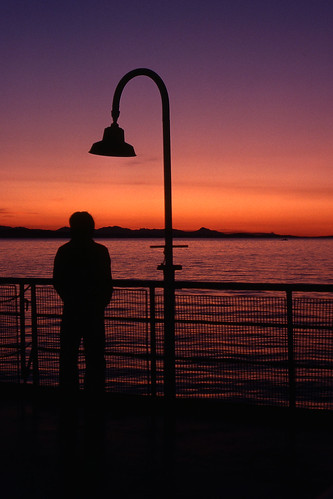 Me, heading back from an excursion to Victoria, BC, scanned from slide. Taken on trip with my dad just prior to my first tour of duty at Regent College, Vancouver, late summer 1980, .
Took it on my old Fujica 801 by my dad. No filters, no post scan fiddling - this is just how it was. We were so incredibly lucky to have the sky the color it was, with the reflections off the water, and to be heading in the right direction! Actually I used my father a a subject, set the lighting and focus, and the gave him the camera to snap the picture. Soon after he bought his own Fujica and got the photo bug.
Lucinda Williams
I'm so happy! I'm going to see Lucinda Williams Sunday night at Carolina Theater with my daughter. Just picked up my tickets - seats right up front in the mezzanine. I know not everyone likes Lucinda William's gravely country-ish music, but I think she is a super songwriter, and kind of like her gravely voice. Here's a nice video from Austin City Limits. Two nights later is Béla Fleck and the Flecktones. That would be cool too. Want to see some amazing bass guitar, check this out!
Monday, September 17, 2007
Guilford Pine Trees
There seem to be four major pine species in Guilford County, with several minor species popping up here and there. It’s fun to learn and notice the differences.
But what is it that makes a tree a pine tree?
First of all, pines are evergreens, that is, they keep their leaves all year round. Actually the leaves are not really permanent, but they are not shed all at once at the coming of winter as with our deciduous trees.
Second, pines have long narrow leaves we commonly call needles rather then leaves. Most pines have needles that come in bunches of two to five, the bunch being connected and held together at the stem end of the needle by a sheath.
Third, pines all have cones. These are the woody (as opposed to pulpy) seed bearing fruits commonly called “pine cones.” The cones we think of as “pine cones” are the female or seed-bearing part of the pine reproductive system.
Pine trees are “gymnosperms,” that is, they produce “naked” seeds, or seeds without ovaries, seeds without surrounding fruits. Pine tree seeds are protected within the woody cone which is itself often covered with sharp scales to discourage animals from eating the seeds, though it is not unusual to see a cone stripped of scales and seeds by a hungry squirrel.
These uncovered seeds of Pine trees, when released from an open woody cone, generally circle to the ground like maple keys. Kids commonly call these pine seeds “helicopters.” When I was a kid we used to punt footballs straight up into the pine trees to knock loose the helicopters, which we then run all around and try to see how many we could catch before they hit the ground.
The very small male cones or catkins at the top of the pine tree produce the wind borne pollen that is released in the late spring covering and fertilizing the temporarily opened female cones below, as well as covering cars and parking lots and lakes and anything else nearby.
Fourth, pine trees tend to grow tall with straight trunks and limbs mostly higher in the tree in older trees. White pines tend to keep their lower limbs the longest, and the limbs on a white pine tend to come out from the trunk in whorls or 5-6 branches.
Fifth, pines do not like shade. The are usually first to invade an abandoned field, although in our part of the Piedmont many deciduous trees are quick to invade abandoned fields as well. Eventually over the course of a hundred years or more pines will become less dominant and hardwoods like oak and hickory more dominant in a forest. Being sun loving, pines and are found more on sunny south facing slopes than shady north facing slopes. A walk around Lake Brandt will make that point clear enough.
There are many evergreen trees that have needles and cones that grow in Guilford County that are not pines, such as firs, hemlocks, and spruces. These are not only shaped differently as trees (more like “Christmas trees”), but have different kinds of needles and cones.
Hemlocks and firs have short flattened needles typically white underneath that grow singly out from the stems, usually along a flattened plane. They have small cones. The needles of spruce are four sided and grow all around the twig, that is, do not grow out in a flat spray from the twigs. Junipers, particularly the very common native “red cedar” have scale like leaves or needles, commonly grow on fence rows, and have a very bushy look, even in older specimens.
The four major pine species of pine tree in Guilford County in estimated order of frequency are Virginia Pine, Short Leaf Pine, White Pine, and Loblolly Pine. On average there are more Shortleaf and Loblolly pines in the southeastern part of the county where the elevation is lower and it is a bit warmer, and more Virginia and White pine in the northwestern part of the county.
But what is it that makes a tree a pine tree?
First of all, pines are evergreens, that is, they keep their leaves all year round. Actually the leaves are not really permanent, but they are not shed all at once at the coming of winter as with our deciduous trees.
Second, pines have long narrow leaves we commonly call needles rather then leaves. Most pines have needles that come in bunches of two to five, the bunch being connected and held together at the stem end of the needle by a sheath.
Third, pines all have cones. These are the woody (as opposed to pulpy) seed bearing fruits commonly called “pine cones.” The cones we think of as “pine cones” are the female or seed-bearing part of the pine reproductive system.
Pine trees are “gymnosperms,” that is, they produce “naked” seeds, or seeds without ovaries, seeds without surrounding fruits. Pine tree seeds are protected within the woody cone which is itself often covered with sharp scales to discourage animals from eating the seeds, though it is not unusual to see a cone stripped of scales and seeds by a hungry squirrel.
These uncovered seeds of Pine trees, when released from an open woody cone, generally circle to the ground like maple keys. Kids commonly call these pine seeds “helicopters.” When I was a kid we used to punt footballs straight up into the pine trees to knock loose the helicopters, which we then run all around and try to see how many we could catch before they hit the ground.
The very small male cones or catkins at the top of the pine tree produce the wind borne pollen that is released in the late spring covering and fertilizing the temporarily opened female cones below, as well as covering cars and parking lots and lakes and anything else nearby.
Fourth, pine trees tend to grow tall with straight trunks and limbs mostly higher in the tree in older trees. White pines tend to keep their lower limbs the longest, and the limbs on a white pine tend to come out from the trunk in whorls or 5-6 branches.
Fifth, pines do not like shade. The are usually first to invade an abandoned field, although in our part of the Piedmont many deciduous trees are quick to invade abandoned fields as well. Eventually over the course of a hundred years or more pines will become less dominant and hardwoods like oak and hickory more dominant in a forest. Being sun loving, pines and are found more on sunny south facing slopes than shady north facing slopes. A walk around Lake Brandt will make that point clear enough.
There are many evergreen trees that have needles and cones that grow in Guilford County that are not pines, such as firs, hemlocks, and spruces. These are not only shaped differently as trees (more like “Christmas trees”), but have different kinds of needles and cones.
Hemlocks and firs have short flattened needles typically white underneath that grow singly out from the stems, usually along a flattened plane. They have small cones. The needles of spruce are four sided and grow all around the twig, that is, do not grow out in a flat spray from the twigs. Junipers, particularly the very common native “red cedar” have scale like leaves or needles, commonly grow on fence rows, and have a very bushy look, even in older specimens.
The four major pine species of pine tree in Guilford County in estimated order of frequency are Virginia Pine, Short Leaf Pine, White Pine, and Loblolly Pine. On average there are more Shortleaf and Loblolly pines in the southeastern part of the county where the elevation is lower and it is a bit warmer, and more Virginia and White pine in the northwestern part of the county.
Photo of the Day - September 17, 2007 - Looking Up Into a Shortleaf Pine, Fisher Park
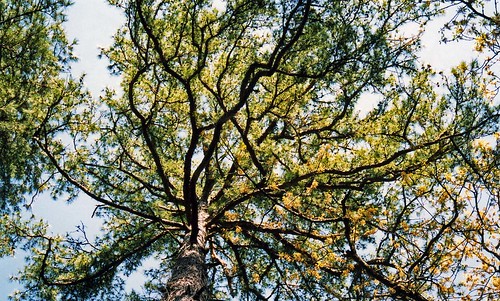 Though I took this picture in Fisher Park, this shows well the way my world looked as I grew up in Columbia SC. As I have often said, I grew up looking at the Carolina blue sky (that is, when it wasn't a hazy grey summer sky) through the limbs of tall pine trees, mostly Loblolly, Short Leaf, and Long Leaf pines. I'm glad we have several good stands of "real" pines here, though not nearly as many as in the drier sandy soil of hot Columbia. It's hard for me to think of Scotch and Virginia Pines as "real" pines - they're kind of wimpy to me. Fisher Park has a lot of nice trees - it's our prettiest park I think.
Saturday, September 15, 2007
Rachel: A Life Remembered
 Today, September 16, 2007, is my little sister Mary's 48th birthday. Mary is the youngest of the four Gillespie children; the rest of us have turned 50 already. It's your turn next little sis! Happy birthday Mary.
September 16 was also the birthday of Mary's first child, her daughter Rachel Elizabeth Johnson. I would like to report that today is Rachel's 23rd birthday, but I cannot.
On February 9, 1987, at the young age of 2 1/2 years old, Rachel died quickly and unexpectedly from an overwhelming bacterial infection that mimicked the flu, invaded her organs, and caused her little body to just shut down. I still feel a sense of anxiety and dread as I remember that phone call received in the middle of a school day as I was teaching at a local school then.
It is impossible to think of Mary's birthday without thinking of Rachel. What would Rachel have been like today? It's hard not to imagine.
Rachel's short life touched many people, and deeply impacted everyone in my family. She was not only Mary and Sandy Johnson's first child. She was my parent's first grandchild, and the very special apple of their eye. She preceded my own first daughter Shannon into this world be a mere four weeks. Since we lived in Columbia at the time, there are lots of pictures of Rachel and Shannon together
Rachel was a fun and delightful and curious child. She learned to walk a little later than some, but she was a regular speedboat crawling. She could have won a crawling race if there had been one. When my daughter started to walk, somewhat early, and often rather wobbily, Rachel would crawl into her like a bowling ball into pins. It was funny. And then when Rachel began to walk, she was a speedy one at that too!
We all miss Rachel, and wish her memory to live on the the lives of the people who knew her, and maybe in some who did not.
I dedicate a set of photographs on my Flickr site to Rachel's memory. Please feel free to look at it, and ponder the fragility of life, and the blessing and good that even a short life can bring into this often hard and cruel world.
The world was a brighter place with Rachel in it. It is a brighter place with her memory still alive in it. Even as a little child she seemed to have real and vital and lively faith. She loved to sing. I cannot sing Holy Holy Holy without thought of her little voice singing that hymn. We all loved you, and miss you, Rachel.
Mary, I know this day can be hard, and may the Lord bless you with richness of memory, even as we all remember not just Rachel, but you on this day, your birthday. Happy Birthday sis!
Brother
Friday, September 14, 2007
Persimmon On the Brain
Last evening I was at some friends’ house helping look after their kids while they attended a funeral. I was walking around in the front yard with one of their sons, and I asked him if their persimmon tree was producing yet. He said yes, and we went over to take a look. Wow – a bumper crop, and many already on the ground. I picked one up, and with that mix of anticipation and dread that accompanies biting into a persimmon, I put a slit in the skin and sucked out enough for a taste, which was sweet, and then I ate the whole thing, skin and seed excepted. I don’t know if the dry weather has caused the persimmon tree to convert the fruit to sugar more than usual, but boy was that persimmon good!
Growing up in Columbia I was blessed to have a large and very productive persimmon tree on the edge of the woods just up from my house. I learned over time how and when to eat persimmons. There are few things as tasty as a sweet ripe persimmon, and few things as awful as a bitter one. A bad or unripe persimmon can create more facial contortions than you are aware you an make. A good persimmon can make you smile with joy.
Once I got used to the fact that a persimmon had to be almost mush to be good to eat, which was kind of gross, I made it a habit every fall to visit that tree many times. Once I even got my mom to make a persimmon cobbler.
I miss the taste. It is quite unique - nothing like it really. And there is a certain fun that goes with the risk of eating persimmon. Sometimes you think you’ve got a sweet one, and then you open up the fruit and suck out the mushy insides (staying away from the skin and seeds), expecting this wonderful tangy sweetness, and instead it feels like your mouth is swelling up from the bitterness, and no matter how much you spit, the taste stays there all day.
Persimmons are rather nondescript straight up smallish trees. Their most distinguishing feature is perhaps their bark – very alligator in nature with very dark small squarish blocks. The bark looks much like a dark dogwood, though the tree is taller, the trunk bigger, and the leaves longer and narrower, and opposite with no teeth. The bark can also be confused with the black gum, though that tree has leaves more like a dogwood and also grows much taller, with its own little blackish fruits. Its bark, though sometimes dark and blocked, is more irregular, and may well be more furrowed. I’m quite fond of the black gum tree. My friend with the persimmon is fortunate to have a black gum right next to it!
Persimmons can grow in various places, on a dry hillside, in an open field, or as an under story tree in a mature forest. They seem not to be terribly picky and take to bad soils fairly well.
Their fruits have long been eaten by man and beast. They were made into cakes of various sorts by our native forbears. Early colonists made persimmon cakes as well as puddings. And to the animals of the forest the persimmon is a favorite. If one is inclined to look, one can find persimmon seeds in the scat of most of our common woods mammals, as well as many birds. Possums love them. If you like having possums around, plant some persimmon trees! Dogs also tend to like persimmons, and seem to be able to discern which ones are good to eat.
Persimmon wood is exceptionally hard and heavy, and was used in great amounts in the hey day of the textile industry as shuttles for the looms. It was a very valuable wood and was thus logged heavily, about everywhere it could be found, and so truly old large persimmons are hard to find today.
Most persimmons you see these days are smallish trees, maybe 30-40 feet. They can get much taller – up to 120 or so feet. The 2005 Guilford County treasure tree program identified a persimmon in Jamestown at 37 feet high and 8 inches in diameter as our county’s biggest, but there have to be bigger ones than that around. Anyway, I’m in a persimmon eating mood, so if you know of any good fruit bearing trees, give me a shout.
Growing up in Columbia I was blessed to have a large and very productive persimmon tree on the edge of the woods just up from my house. I learned over time how and when to eat persimmons. There are few things as tasty as a sweet ripe persimmon, and few things as awful as a bitter one. A bad or unripe persimmon can create more facial contortions than you are aware you an make. A good persimmon can make you smile with joy.
Once I got used to the fact that a persimmon had to be almost mush to be good to eat, which was kind of gross, I made it a habit every fall to visit that tree many times. Once I even got my mom to make a persimmon cobbler.
I miss the taste. It is quite unique - nothing like it really. And there is a certain fun that goes with the risk of eating persimmon. Sometimes you think you’ve got a sweet one, and then you open up the fruit and suck out the mushy insides (staying away from the skin and seeds), expecting this wonderful tangy sweetness, and instead it feels like your mouth is swelling up from the bitterness, and no matter how much you spit, the taste stays there all day.
Persimmons are rather nondescript straight up smallish trees. Their most distinguishing feature is perhaps their bark – very alligator in nature with very dark small squarish blocks. The bark looks much like a dark dogwood, though the tree is taller, the trunk bigger, and the leaves longer and narrower, and opposite with no teeth. The bark can also be confused with the black gum, though that tree has leaves more like a dogwood and also grows much taller, with its own little blackish fruits. Its bark, though sometimes dark and blocked, is more irregular, and may well be more furrowed. I’m quite fond of the black gum tree. My friend with the persimmon is fortunate to have a black gum right next to it!
Persimmons can grow in various places, on a dry hillside, in an open field, or as an under story tree in a mature forest. They seem not to be terribly picky and take to bad soils fairly well.
Their fruits have long been eaten by man and beast. They were made into cakes of various sorts by our native forbears. Early colonists made persimmon cakes as well as puddings. And to the animals of the forest the persimmon is a favorite. If one is inclined to look, one can find persimmon seeds in the scat of most of our common woods mammals, as well as many birds. Possums love them. If you like having possums around, plant some persimmon trees! Dogs also tend to like persimmons, and seem to be able to discern which ones are good to eat.
Persimmon wood is exceptionally hard and heavy, and was used in great amounts in the hey day of the textile industry as shuttles for the looms. It was a very valuable wood and was thus logged heavily, about everywhere it could be found, and so truly old large persimmons are hard to find today.
Most persimmons you see these days are smallish trees, maybe 30-40 feet. They can get much taller – up to 120 or so feet. The 2005 Guilford County treasure tree program identified a persimmon in Jamestown at 37 feet high and 8 inches in diameter as our county’s biggest, but there have to be bigger ones than that around. Anyway, I’m in a persimmon eating mood, so if you know of any good fruit bearing trees, give me a shout.
Subscribe to:
Posts (Atom)


 Posts
Posts


