Pages

Showing posts with label Trees. Show all posts

Saturday, October 16, 2010

National Champ Loblolly

Congaree 10-10-10 Giant Loblolly

Congaree National Park, 10-10-10

Check Out on Flickr

Monday, December 14, 2009

Trees in Winter

There was a time in my life during the season between the end of daylight savings time and the winter solstice, when I think I was prone to a mild case of seasonal affective disorder, or maybe just the early sundown blues. Thankfully that time is long past. I’m too busy now for one thing. And the other thing is that I have fallen in love with the woods in winter. I look forward to winter woods like some people look forward to spring flowers. More than anything, it is the trees. I love trees in winter.

For the sake of modesty and warmth people need to put on clothes. But clothes hide what people “really” look like (though I’ll just take the clothed look, thank you). As for trees, all those leaves, as beautiful and green as they are, hide the unique and often magnificent personality of the tree beneath. The uniqueness of each and every tree is more evident in its nakedness.

There is a White Oak out my side window. It is almost completely leafless now, with only a few red hanger-on leaves dangling here and there. I see its twisted and gnarly branches more clearly than ever. They reveal its story. This White Oak grew up in its early years with some good competition, but then, that competition diminished. About thirty feet up some very stout limbs grow straight out from the trunk. I am guessing, by the size and age of the tree, that the “competition” was cleared for the building of the houses around, and the builders decided to spare that White Oak. It’s a grand old tree, though it’s a little sick, and I worry for it.

It’s easy to notice tree bark in winter. I am one of those odd fellows who thinks that tree bark is very beautiful and quite cool. The sun likes to highlight the bark of a leafless tree, especially the higher-up bark. Winter is time for the bark to shine. Some bark literally does shine. Sycamore trees peel off huge plates revealing a bright chalky white underbark. Take a walk through Latham Park and you will see plenty of that.

Lots of stuff hangs from trees in winter letting you know about the tree. Tulip Poplar balls like to hang around for a while bouncing in the wind. Plus the last Spring flower cups are very visible reaching to the sky at the end of the high stems. Locust Tree bean pods like to flutter in the breeze throughout the winter rattling like old bones. There’s always the stubborn Sweet Gum balls that won’t let go, just waiting to drop in early Spring when your are just first walking out in your bare feet! Gotcha!

Many trees keep their berries throughout the winter. You’d think for example that the birds would eat up all the dogwood berries right away, but the berries often dry out a little and provide food for the birds all winter long. Same for Red Cedar berries, those lovely little gray-blue balls that often cover a Cedar tree. Same for Black Gum. Same for American Holly. I know our Holly bush is not a Holly tree, but it brings joy all winter watching the Mockingbirds eat berries from our Holly bush. It’s like they know how to ration the supply. Interesting.

You may need to be a bit of a tree geek for this one, but tree buds and tree stems are fascinating in the winter. By looking at a bare tree stem you can tell how much it grew the last growing season. It’s really easy. You can also tell a lot about the leaves, even when there aren’t any. You can tell if they come off the stem opposite to each other or whether they come of the stem in whorls. You can also tell how many main tree “veins” feed each leaf. From this, more or less, you can often guess if the leaves are compound or not. You can know a lot about what kind of tree it is by how the buds are arranged. Is there one big bud at the end of the stem? Is there a cluster of buds at the end of the stem? Is the bud really at the end or sort of off to the side toward the end? In fact, you can key a tree, that is determine what it is, in winter, without the leaves at all.

The future fate of life on earth is nestled in those little buds. That is just barely an exaggeration. What is it that protects the life inside that bud (and hence next year's growth, and next year's ability to feed flower and seed) from the cold of winter? It is those scales around the bud. Different trees have different kinds of scales. Some bud scales are like two plates meeting in the middle. Some are like fish scales. You can tell a lot about a tree from those scales.

Winter is the time for Pine trees to make their presence known. They kind of pop out and say "We're here" in winter. Hey, I am a South Carolina boy. I was raised on climbing Pine trees to the top, looking up to the deep blue sky through the black branches and green needles of Pine trees, spending half an afternoon trying to get Pine sap off my favorite jeans, engaged for hours in Pine cone wars with the enemy across the wall next door, and nursing skinned up legs from shimmying up and down Pine trunks. In Greensboro there are a few places where I like to go just to breathe in the Pine tree air, peel off some plates of Pine tree bark, fiddle with Pine tree cones, and just generally feel at home.

It’s nice to walk the woods in winter. You can see farther for one thing. You can tell more easily what has been the history of the land you're walking for another. I like trying to figure that out by the ages of the trees, the kinds of trees, the ways that the terrain has been changed by man, how or where a fire may have swept through fifty or so years ago. It’s a kind of sleuthing that I enjoy.

Maybe my favorite thing to do, especially on a cold winter day, is to find a nice stout tree that I can sit against, one with the sun shining full force right on the bottom of the trunk, and just take a seat. Oh how I love the sun on my face in winter. And there I sit. No bugs. Quiet. As quiet as I can be. If the winds are right, and if I'm still enough, the animals will soon not notice me. Many times right here in Greensboro deer have walked near, hawks have flown and perched close by, even squirrels have nervously scampered quite close to my feet. I cannot measure the joy of such times.

Such joy gives me strength to go back and re-enter the world of people. Trees are not fickle and moody and complicated and proud like people, like me. They just "are." How I love them so.

(edited from a post first written November 17, 2006)

Friday, November 06, 2009

A VERY Tall Tulip Poplar - Piedmont Trail

Liriodendron tulipifera. Piedmont Trail, Greensboro, NC. More Pictures

Friday, October 30, 2009

Sycamore and Tulip Poplar

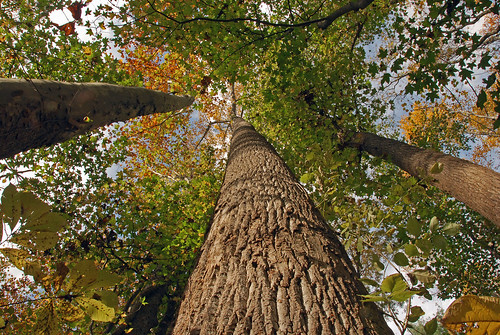
American Sycamore and Tulip Poplar, Piedmont Trail, Greensboro watershed trail system, Greensboro, NC. This particular tulip poplar is the not the biggest but may be the tallest I have personally seen in Guilford County. The first limbs appear to be maybe 80+ feet up. Sycamore and Tulip Poplar are the two tallest of our Eastern trees. These look like they are in a race. They are kind of. Check out a few more shots of these trees on my Flickr photostream.
Wednesday, September 09, 2009

Black Gum

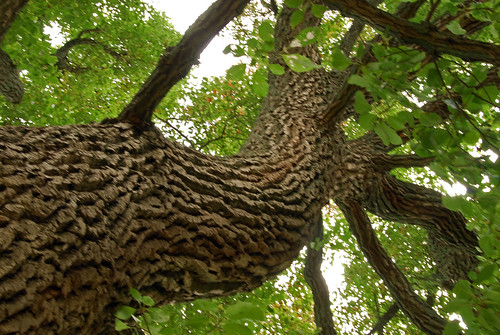
Same tree as below, main trunk. Nyssa sylvatica. Green Hill Cemetery, Greensboro, NC.

Tuesday, September 08, 2009

Black Gum - Green Hill Cemetery Greensboro


In the yard where I grew up in Columbia, SC, out near the street, was an area we would call a “natural area” these days, containing several old Dogwoods, two “Scrub Oaks," and a tree which looked and “acted” very much like a Dogwood, but which wasn’t. I always loved that tree. It is still there, seemingly the same size it was thirty years ago.

When I say that it “looked” like a Dogwood what I mean is that it had leaves very Dogwood like, though much glossier and waxy, and a little bigger. Not only that but the bark was very dark, fissured both horizontally and vertically, giving it an alligator skin appearance, like Dogwood bark. When I say it “acted” like a Dogwood I mean that it’s leaves turned a deep red in the fall, actually a deeper red than Dogwood leaves, and sometimes with a dash of deep orange thrown in.

But it wasn’t a Dogwood. It was a Black Gum. It didn’t have red berries but small blue-ish berries which hung from little stems. And it was bigger, that is, taller and bigger around. And it’s limbs were different. They were kind of squatty and tended to grow straight out from the trunk. And though I didn’t notice such things until older, its leaves, rather than growing from the stem in pairs on opposite sides of the stem, grew “alternately,” that is, a leaf here, then a little ways up on the other side of the stem, a leaf there, and so on.

I found out one day another way that Black Gums “act” like Dogwoods. Our town would be hit hard every winter or two by a freezing rain storm. Oh how the loblolly, shortleaf, and long leaf pine tree limbs would go a popping! They would sound like guns firing. Some of us crazy kids would go out limb dodging during these freezing rain storms. We’d stand around under a pine tree and every time we’d here a “pop” we’d take off. Usually it was a near by pine limb popping, but sometimes we’d clear out a second before a loblolly limb would land just where we had been standing. Did I ever say we were nuts?

Well, sometimes the deciduous trees did not fare well in these storms either. They tended not to lose a limb here or there as much as just topple over all together. A I got older I worked for a lot of elderly neighbors who would want a felled tree chain sawed into eighteen inch lengths and then split for firewood. Many of these would be Southern Red Oaks which split like the water of the Red Sea. It was downright fun to split that stuff.

But then other trees would fall, like Dogwoods. Ever tried to split a Dogwood? Well, don’t try. Just burn the thing whole in a hot fire. The same goes for Black Gum, but worse. You could chain saw through it but try to split one and the maul or axe would just as likely bounce up, or dig in just enough where you couldn’t pull axe and tree apart.

Because of this quality, Black Gum was revered like Dogwood for uses where high shock resistance was useful – such as in the growing industrial textile industry, or for toys, pulley rollers or gunstocks, or even as handles for mauls or heavy axes. It was the hardest wood around that I knew of, other than maybe hickory.

My neighborhood was full of ‘Possums. And ‘Possums loved the little berries or drupes of the Black Gum. Ever heard the jig “'Possum Up De Gum Tree”? Well, it’s the Black Gum’s little blue berries that that ole ‘Possum was after.

Black Gums are not that common, and for some reason they don’t live that long generally. They tend to grow as an under story tree in the mature piedmont forest.

I’ve grown fond of three Black Gums in Guilford County and two of the three have died. They tend to rot out, with the tops dying first, and one I know of got hit by lightning.

The biggest Black Gum I have ever seen was is in Green Hill Cemetery - the one in the picture above. It must be well over a hundred years old - Black Gums grow slowly and the Green Hill Gum is almost three feet in diameter.

According to the booklet “Treasure Trees of Guilford County 2005” the largest Black Gum in Guilford County is in McLeansville, and is 87 feet high, 39.5 inches in diameter, with a crown spread of 55 feet. That my friends is a big Black Gum.

By the way, the scientific name for Black Gum is Nyssa sylvatica. Nyssa is a Greek word meaning end or post or trunk. Nissa is a Scandinavian word for elf or fairy. I am not sure which is the true origin of this tree name – whether “post of the forest” or “elf of the forest.”

Black Gum may also be called Black Tupelo.

You can get more information the Black Gum, and see pictures, here, here, or here.

Copyright @2009 Joel Gillespie

Sunday, July 19, 2009

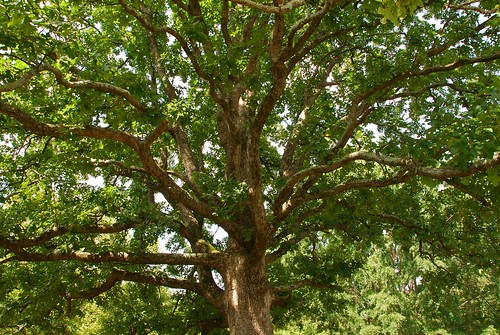
Post Oak Tree, Green Hill Cemetery, Greensboro


See my new Flickr set - trees.

Look here for a more detailed description of this wonderful oak species.

Friday, November 17, 2006

Trees in Winter

There was a time in my life during this season between the end of daylight savings time and the winters solstice, when I think I was prone to a mild case of seasonal affective disorder, or, in my case, maybe just the sundown blues. Thankfully that is long past. I’m too busy now for one thing. And the other thing is that I have fallen in love with the woods in winter. I look forward to winter woods like some people look forward to spring flowers. Moore than anything, it is the trees. I love trees in winter.

For the sake of modesty and warmth people need to put on clothes. Yes, it hides what they “really” look like, but I’ll just take the clothed look thank you. But as for trees, all the leaves, as beautiful and green as they are, hide the unique and often magnificent personality of the tree beneath. The uniqueness of each and every tree is more evident in nakedness.

There is a White Oak out my side window. It is almost completely leafless now, with only a few red hanger-on leaves dangling here and there. I see its twisted and gnarly branches more clearly than ever. They reveal its story. This White Oak grew up in its early years with some good competition, but then, that competition diminished. About thirty feet up some very stout limbs grow straight out from the trunk. I am guessing, by the size and age of the tree, that the “competition” was cleared for the building of the houses around, and the builders decided to spare that White Oak. It’s a grand old tree, though it’s a little sick, and I worry for it.

It’s easy to notice tree bark in winter. I am one of those odd fellows who thinks that tree bark is very beautiful and quite cool. The sun likes to highlight the bark of a leafless tree, especially the higher-up bark. Winter is time for the bark to shine. Some bark literally does shine. Sycamore trees peels off huge plates revealing a bright chalky white under bark. Take a walk through Latham Park and you will see plenty of that.

Lots of stuff hangs from trees in winter letting you know about the tree. Tulip Poplar balls like to hang around for a while bouncing in the wind. Plus the last Spring flower cups are very visible reaching to the sky at the end of the high stems. Locust Tree bean pods like to flutter in the breeze throughout the winter rattling like old bones. There’s always the stubborn Sweet Gum balls that won’t let go, just waiting to drop in early Spring when your are just first walking out in your bare feet! Gotcha!

Many trees keep their berries throughout the winter. You’d think for example that the birds would eat up all the dogwood berries right away, but the berries often dry out a little and provide food for the birds all winter long. Same for Red Cedar berries, those lovely little gray-blue balls that often cover a Cedar tree. Same for Black Gum. Same for American Holly. I know our Holly bush is not a Holly tree, but it brings joy all winter watching the mockingbirds eat berries from our Holly bush. It’s like they know how to ration the supply. Interesting.

You may need to be a bit of a tree geek for this one, but tree buds and tree stems are fascinating in the winter. By looking at a bare tree stem you can tell how much it grew the last growing season. It’s really easy. You can also tell a lot about the leaves, even when there aren’t any. You can tell if they come off the stem opposite to each other or whether they come of the stem in whorls. You can also tell how many main tree “veins” feed each leaf. From this, more or less, you can often guess if the leaves are compound or not. You can know a lot about what kind of tree it is by how the buds are arranged. Is there one big bud at the end of the stem? Is there a cluster of buds at the end of the stem? Is the bud really at the end or sort of off to the side toward the end? In fact, you can key a tree, that is determine what it is, in winter, without the leaves at all.

The future fate of life on earth is nestled in those little buds. That is just barely an exaggeration. What is it that protects the life inside that bud (and hence next year's growth, and next year's ability to feed flower and seed) from the cold of winter? It is those scales around the bud. Different trees have different kinds of scales. Some bud scales are like two plates meeting in the middle. Some are like fish scales. You can tell a lot about a tree from those scales.

Winter is the time for Pine trees to make their presence known. They kind of pop out and say "We're here" in winter. Hey, I am a South Carolina boy. I was raised on climbing Pine trees to the top, looking up to the deep blue sky through the black branches and green needles of Pine trees, spending half an afternoon trying to get Pine sap off my favorite jeans, engaged for hours in Pine cone wars with the enemy across the wall next door, and nursing skinned up legs from shimmying up and down Pine trunks. In Greensboro there are a few places where I like to go just to breathe in the Pine tree air, peel off some plates of Pine tree bark, fiddle with Pine tree cones, and just generally feel at home.

It’s nice to walk the woods in winter. You can see farther for one thing. You can tell more easily what has been the history of the land you're walking for another. I like trying to figure that out by the ages of the trees, the kinds of trees, the ways that the terrain has been changed by man, how or where a fire may have swept through fifty or so years ago. It’s a kind of sleuthing that I enjoy.

Maybe my favorite thing to do, especially on a cold winter day, is to find a nice stout tree that I can sit against, one with the sun shining full force right on the bottom of the trunk, and just take a seat. Oh how I love the sun on my face in winter. And there I sit. No bugs. Quiet. As quiet as I can be. If the winds are right, and if you’re still enough, the animals will soon not notice you, and you will get lucky. Many times right here in Greensboro deer have walked near, hawks have flown and perched close by, even squirrels have nervously scampered quite close to my feet. I cannot measure the joy of such times.

Such joy gives me strength to go back and re-enter the world of people. Trees are not fickle and moody and complicated and proud like people, like me. How I love them so.